

Vegan Food Delivery UK: How to Choose in 2026
It's Friday evening, and everyone wants something different. You'd like dinner without cooking, someone else wants ingredients for tomorrow, and your weekend guest has asked whether there'll be a plant-based cheeseboard. Searching for vegan food delivery in the UK brings up all of these options, but they're not interchangeable.
The useful question isn't which service is best overall. It's which delivery format suits the job, your kitchen and the people eating. Start there, then check the practical details that matter: dietary information, delivery arrangements, portions and storage.
Table of Contents
- Five Ways Vegan Food Reaches a UK Door
- How to Pick the Right Service for Your Kitchen
- Why a Vegan Label Is Not an Allergen Promise
- How to Order Chill and Store a Delivery
- Boards Gifts and Mixed-Diet Gatherings
- Where a Specialist Deli Fits Beside the Apps
- Choose Your Next Delivery With Confidence
Five Ways Vegan Food Reaches a UK Door
There are five main formats to choose from: restaurant apps, ready-meal boxes, recipe kits, grocery and marketplace deliveries, and specialist chilled delis. Each saves a different kind of effort. Ordering supper and organising a celebration might both involve a delivery, but they need different baskets.
UK vegan delivery formats at a glance
| Format | Best for | Arrives as | Coverage | Cost pattern |
|---|---|---|---|---|
| Restaurant apps | Tonight's hot meal | Ready to eat, usually hot | Postcode dependent, strongest in towns | Per dish plus delivery and service fees |
| Ready-meal boxes | Low-effort lunches and dinners | Chilled meals, or frozen where stated | Nationwide services on set delivery days, subject to postcode | Weekly plan; check pause and skip terms |
| Recipe meal kits | Scratch cooking for a small household | Chilled ingredients and a method | Most of the UK through eligible postcodes and chosen days | Compare portions you'll actually eat |
| Grocery and marketplaces | The weekly shop | Mixed chilled and ambient | Supermarket slots or courier delivery | Basket total; offers change |
| Specialist chilled deli | Boards, gifts and discovery | Chilled cheese plus pantry accompaniments | UK-wide postal or courier services; some offer Camden tastings | Premium items; compare bundles with separate items |
These are typical service patterns, not promises from every seller. Check the live basket in GBP, including delivery, before deciding.
Choose the effort you want to remove
Restaurant apps suit the moment when nobody wants to chop, cook or wash a saucepan. Enter your postcode first, because the available kitchens and estimated arrival times are local. A vegan menu filter narrows the dishes shown; it doesn't tell you whether the restaurant has a separate kitchen.
Ready-meal subscriptions remove most preparation but still leave you in charge of reheating and planning when to eat each meal. They're useful for work lunches or evenings when cooking feels like another task. Check whether you're making a one-off purchase or starting a recurring order.
Recipe kits do something different: they remove meal planning and much of the measuring, not the cooking. A kit can help a household try an unfamiliar dish without buying full packs of every seasoning. Read the method before ordering, especially if you'll need an oven, blender or several pans.
Grocery deliveries offer the broadest practical basket. You can combine tofu, plant-based mince, vegetables, pasta, rice, noodles and cupboard staples rather than choosing complete meals. That gives you flexibility, but you'll still need a plan for using the fresh ingredients.
A specialist chilled deli is more useful when the food itself is part of the occasion. Artisan dairy-free cheese, crackers, chutneys and sweet treats belong in a discovery or entertaining basket, rather than being treated as substitutes for a hot takeaway. A family cheese bundle is one format to examine when you'd rather start with a selection than assemble everything individually.
You don't need to be strictly vegan to use these services
The audience has long included people trying plant-based food occasionally: Deliveroo's account of ordering habits reported that 82% of UK customers surveyed had tried vegan food, while one-third of its consumers followed a vegetarian, pescatarian, flexitarian or vegan diet.
That matters in a mixed household. You don't have to agree on a dietary identity to agree on a good dinner, and a shared plant-based order can be chosen for convenience or flavour.
Start with the job: Circle one primary format before browsing menus. You can add accompaniments afterwards, but a clear starting point makes the choice easier.
How to Pick the Right Service for Your Kitchen
A promising menu isn't enough if the delivery arrives while you're out, the portions don't match your household, or the information you need is missing. Use a short kitchen test before getting attached to a particular basket.
Start with the people eating
First, separate food preferences from dietary requirements. A committed vegan may want clear confirmation about ingredients and preparation, while someone avoiding milk or gluten needs information specific to that requirement. A mixed table may need several checks at once.
Look for written dietary and allergen details before checkout. If the only information is a small dietary icon, ask for the full product or dish information rather than interpreting the icon yourself.
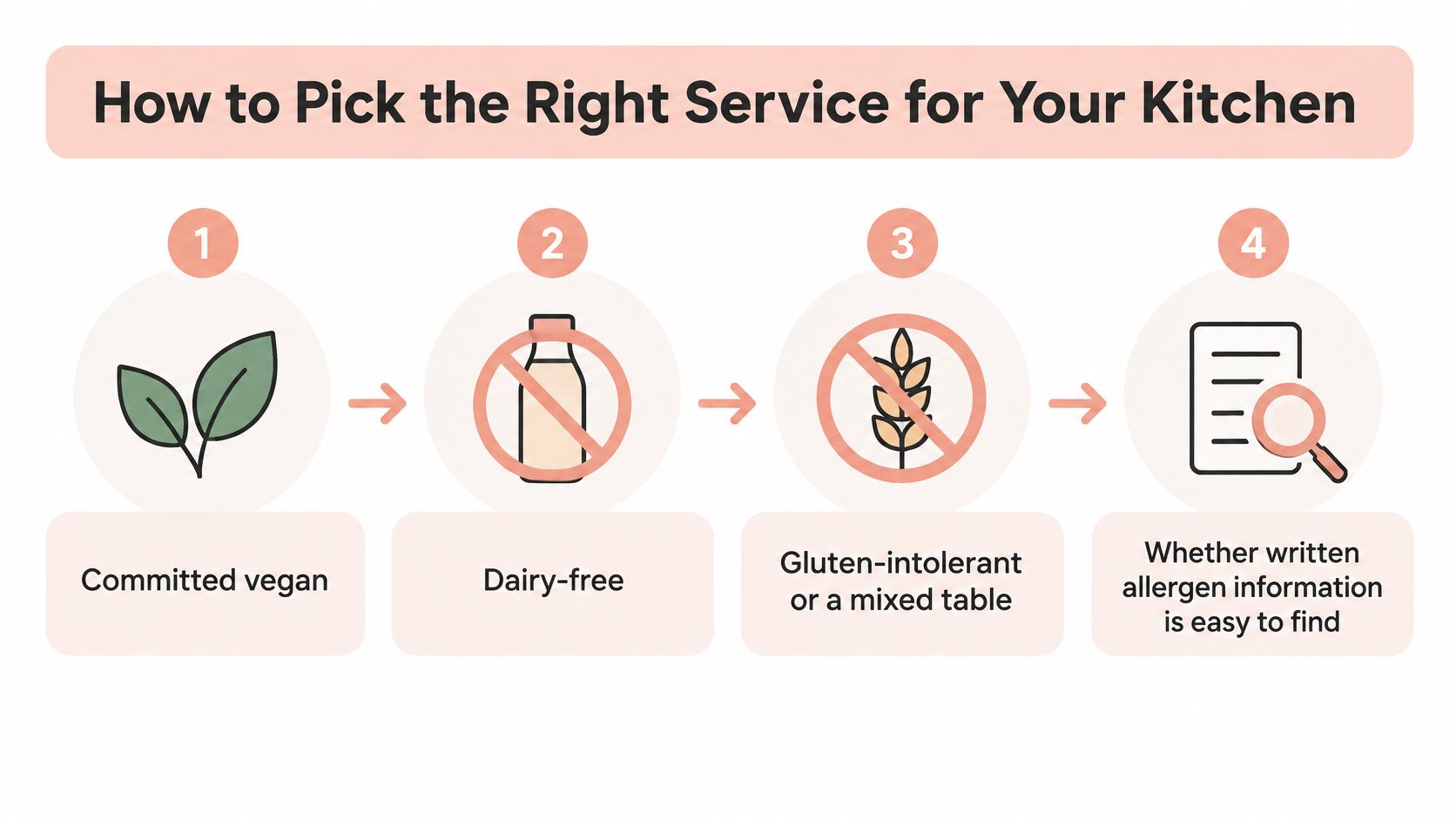
Next, think about packaging and how you'll use the food. Hot takeaway suits a meal you'll eat when it arrives. A chilled order needs room in the fridge, suitable packaging for its journey and enough remaining shelf life for your plans.
Then check coverage against your actual diary. Local delivery requires an available service at your address; courier deliveries may run on selected dispatch days. Grocery slots can be harder to secure around busy periods, so book the slot before planning an elaborate menu around it.
Finally, compare money in a way that reflects what you'll eat. Divide the live basket total, including compulsory fees, by the portions you expect to use. A large box isn't good value if half of it won't fit your schedule.
Match the service to an ordinary situation
Which delivery fits this situation
| Situation | Start with | Check before you pay |
|---|---|---|
| Weeknight for one | Restaurant app or ready meal | Portions, fees and whether it will be eaten tonight |
| Family scratch cooking | Recipe kit or grocery slot | Stated serving size, household appetite and dates on perishables |
| Allergy or intolerance | Prepacked food with a full label | May-contain wording and written confirmation where needed |
| Cheeseboard for guests | Specialist chilled deli | Delivery window and use-by dates on cheeses |
| Gift with a fixed date | Gift card or curated box | Courier day versus the occasion |
| London or Camden visit | In-person tasting plus a later online order | Event date and what can travel home chilled |
Say you're a city professional ordering after work on several evenings. Ready meals might suit the nights you can plan ahead, while a local app handles an unexpectedly late finish. You don't need to commit to one format for every meal.
For a household that enjoys cooking, groceries may be more adaptable than kits. A kit is useful when choosing recipes is the tiring part; a grocery basket is useful when you already know what you like and want control over portions.
An allergy-led kitchen needs a different priority. Start with the quality and accessibility of the information, then consider flavour and convenience. For a gift, reverse the usual shopping habit: check the recipient's availability before choosing chilled food.
A delivery that fits your calendar is more useful than an impressive basket you can't receive or finish.
The rule of thumb is straightforward: tonight's dinner points towards an app; scratch cooking points towards kits or groceries; boards, hampers and pantry top-ups point towards grocery or a curated deli. Choose the format before comparing individual dishes.
Why a Vegan Label Is Not an Allergen Promise
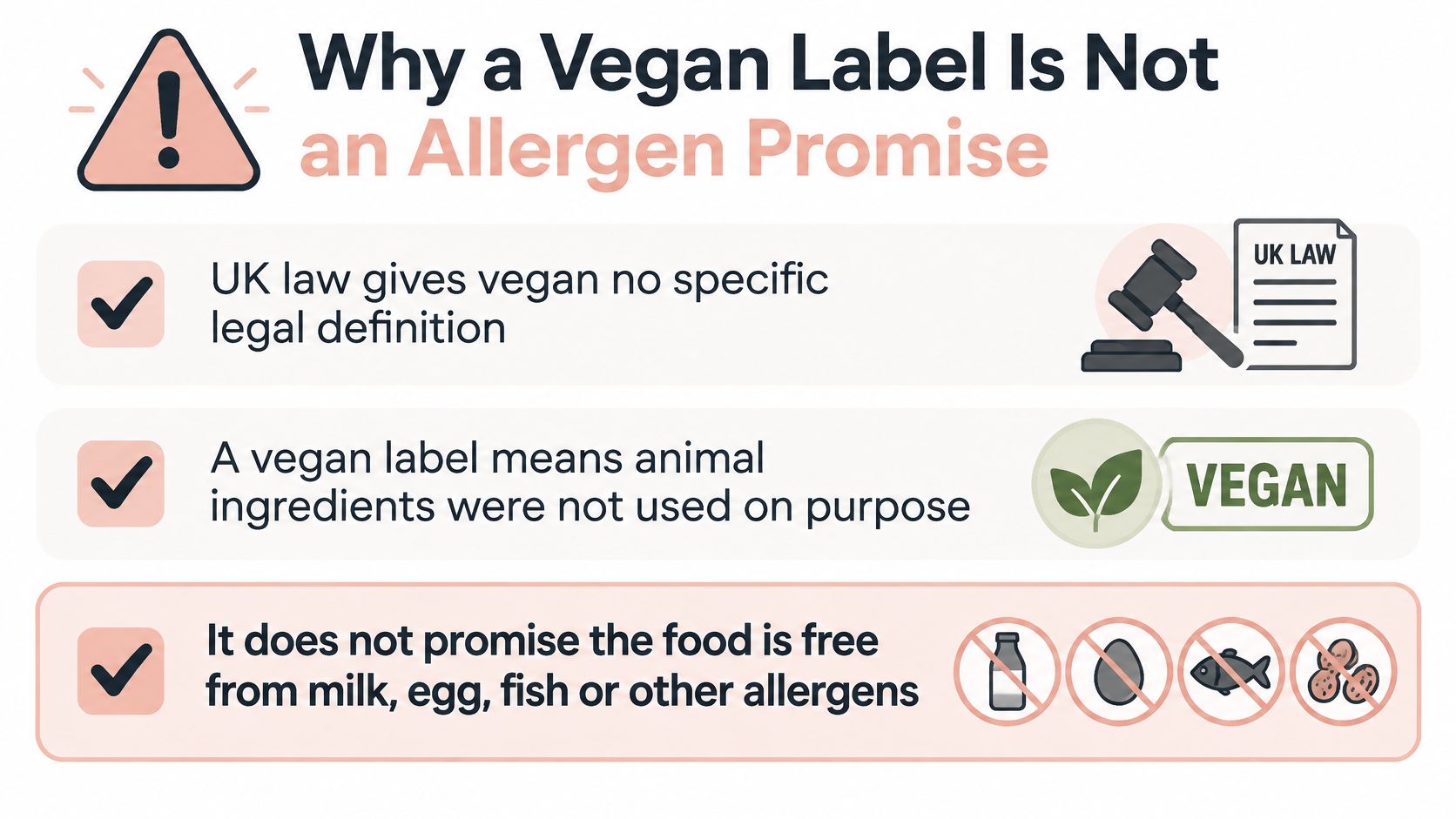
Vegan and free-from answer different questions. According to UK Government guidance on vegan food labelling, vegan has no specific legal definition in UK food law, and a vegan label means no animal-origin ingredients were intentionally used. It doesn't guarantee the absence of accidental traces from shared equipment, storage or preparation areas.
A free-from or allergen-free claim requires strict controls against cross-contamination. Someone with a milk or egg allergy therefore shouldn't use a vegan description as their only suitability check, even when the ingredients sound entirely plant-based.
Read the ingredient information, not just the dietary badge
The Government's food allergy and intolerance guidance identifies 14 regulated allergens: cereals containing gluten, crustaceans, eggs, fish, peanuts, soya, milk, nuts, celery, mustard, sesame, sulphites, lupin and molluscs. The guidance also explains that allergens must be emphasised in prepacked ingredients lists, that relevant allergen information must be available before a distance order and when it's supplied, and that since 1 October 2021, food prepacked for direct sale needs its name, a full ingredients list and emphasised allergens.
A fully plant-based meal can still contain soya, nuts, sesame, mustard or cereals containing gluten. Think of a nut-based cheese, sesame dressing or soya-based meat-free filling: none needs an animal ingredient to introduce an allergen.
Gluten-free isn't the same as wheat-free, either. Treat those as separate claims and check the information relevant to the person eating, rather than assuming one label answers both questions.
Written communication deserves particular attention: Food Standards Agency findings covering England, Wales and Northern Ireland found that only 47% of adults with food hypersensitivities who ordered takeaway through distance selling received written allergen information on their most recent order, and only 18% of those who declared allergen requirements received written confirmation that those requirements had been met.
Make these checks before committing to an order
- Read the full ingredients. Don't stop at the dish title or the vegan filter.
- Find precautionary wording. Look for may-contain statements and information about shared facilities.
- Ask about preparation. Establish whether equipment, utensils or preparation areas are shared.
- Request written confirmation. If you've declared an allergy, ask the business to confirm how it will handle that requirement.
- Recheck the delivered pack. Supplier details and recipes can change, and the batch label may be more current than the webpage.
For example, a dairy-free cheese could have nuts as a main ingredient, while a plant-based sauce could contain mustard. Neither is a contradiction. The useful distinction is between what the recipe deliberately includes and what could be present through cross-contact.
If the seller can't answer a necessary question clearly, don't fill the gap with an assumption. Choose an alternative with suitable information, and make sure anyone receiving the order knows which pack belongs to which person.
How to Order Chill and Store a Delivery
A little planning at checkout prevents a chilled order becoming an awkward doorstep problem. Use this routine for cheese, prepared meals and deli items, keeping the packaging instructions with the food.
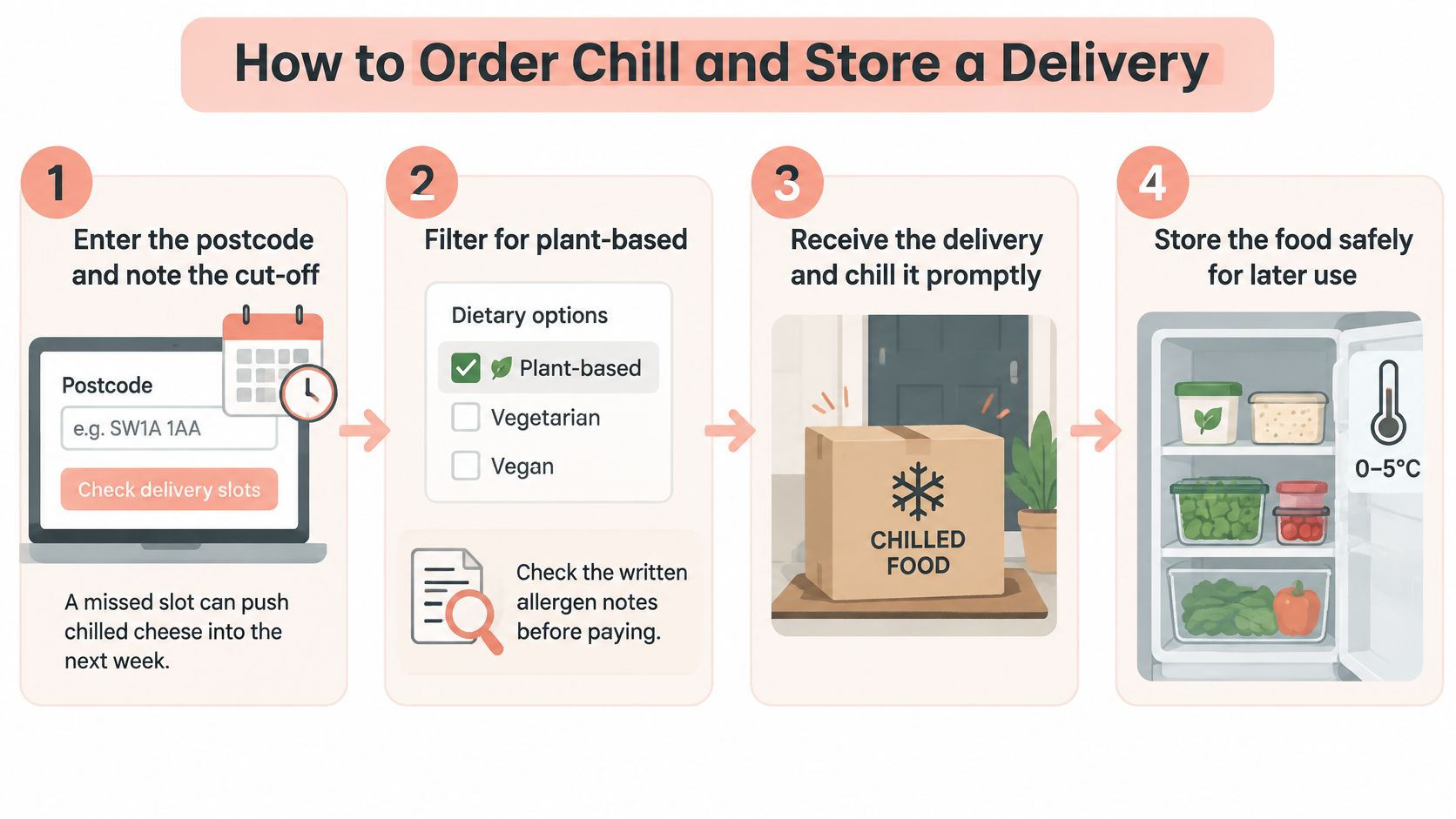
- Enter your postcode and note the cut-off. Missing a dispatch deadline can move your order beyond the day you intended to serve it.
- Filter, then verify. Use plant-based filters to narrow the selection, then complete the dietary checks before paying.
- Check the pack information. The Government's food-labelling guidance sets out mandatory details for applicable prepacked foods, including the food name, ingredients and allergens, net quantity, date information and responsible business details.
- Arrange for someone to receive it. Insulated liners and ice packs aren't a reason to leave chilled food sitting in a hallway or on a doorstep.
- Refrigerate chilled items promptly. Aim for a fridge temperature of 0 to 5°C, and don't refreeze anything that arrived thawed.
- Separate cupboard items. Keep crackers, unopened shelf-stable chutneys and pickles, pasta, oils, coffee and chocolate in a cool cupboard unless their labels say otherwise.
- Use the dates properly. Eat use-by items first, and treat best-before dates as quality guidance rather than safety deadlines.
- Keep the physical label. Retain it until the food is finished, because a webpage can lag behind the batch information.
Keep packaging and meal planning separate
For anyone comparing takeaway packaging, Monopack ltd's guide to eco-friendly containers for hot food offers packaging context. Hot-food containers and chilled transit packaging serve different purposes, so don't treat them as interchangeable.
For a simple storage plan, eat the shortest-dated item tonight, reserve suitably dated cheese for a board, and keep ambient pasta and sauce for a later evening. You're allocating food to meals, not opening everything on arrival.
Boards Gifts and Mixed-Diet Gatherings
Six guests, two of them vegan, and one cheese board to serve them all. The way through is contrast: pick different styles rather than several similar blocks, then add accompaniments everyone can share.
Build around flavour and texture
Board pairings for six
| Cheese style | Pair with | Why it works |
|---|---|---|
| Soft bloomy style | Plant-based crackers and fruit chutney | Creamy texture meets crisp, sweet contrast |
| Blue style | Pear or fig chutney and nuts, after checking labels | Sharp flavour balanced by sweetness |
| Smoked style | Olives and pickles | Smoky notes contrast with salty, sharp bites |
| Feta-style or mozzarella-style | Olives, fresh herbs and a spread | Fresh contrast to richer styles |
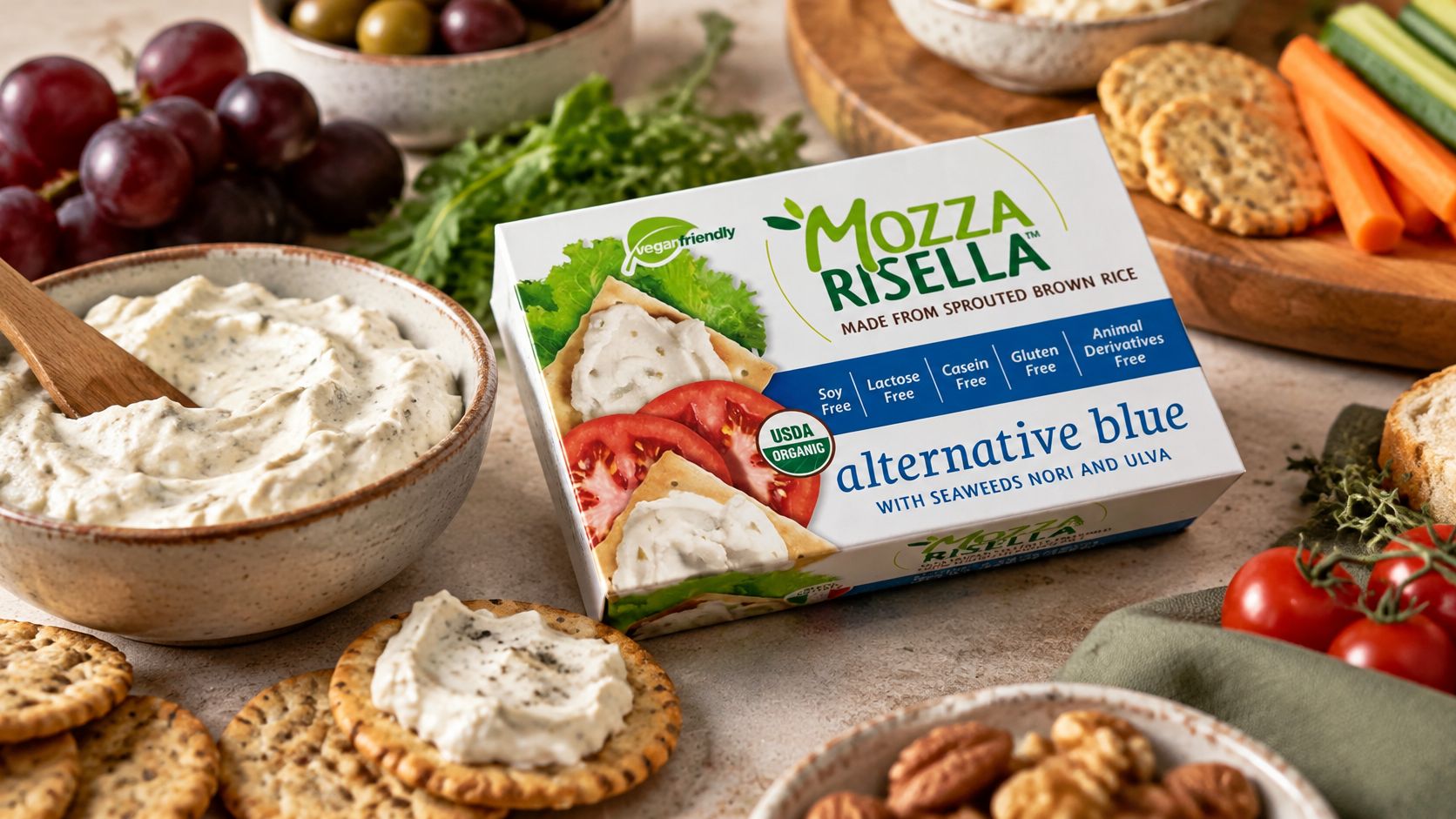
For a spreadable option, BlueRisella Spreadable Blue Cheese 150g has a creamy texture and tangy, earthy flavour suited to crackers or stirring into sauces.
Serve in order of strength. Fresh and bloomy styles come first, then smoked, then blue, so the sharpest cheese arrives after palates have warmed up rather than flattening the milder pieces beside it. Allow a few small pieces of each style per person, with more when the board is the main event. Add pumpkin seeds for crunch if suitable for your guests, and keep serving utensils separate where dietary requirements call for it.
Turn the occasion into a useful basket
A luxury vegan cheese collection covers several styles in one order, which saves you from guessing how many separate blocks make a balanced board. If you prefer choosing piece by piece, build around one soft, one smoked and one blue style, then fill the gaps with crackers and chutney. Leftover cheese can join cupboard pasta and a jarred sauce the following evening.
For gifts, consider a cheese bundle, vegan chocolate, coffee or tea; choose a gift card when favourites are unknown. If the occasion calls for a hosted venue rather than a delivery, private events at Kunde Winery is a winery event option to explore.
A shared board can feel more welcoming than a separate vegan plate, provided everyone's dietary needs are accommodated.
Where a Specialist Deli Fits Beside the Apps
Mainstream delivery services already handle useful jobs. A local app can bring a hot plant-based curry when cooking isn't happening, while a supermarket order can cover vegetables, breakfast staples and the rest of the weekly shop. There's no need to replace either habit if it works for you.
A specialist deli addresses a narrower need: choosing artisan dairy-free cheeses from several makers, with accompaniments, in one order. That's helpful when you care about the difference between a soft bloomy style and a smoked or blue-style cheese, rather than needing something to melt into dinner.
Browse by style, then add what belongs beside it
Look for contrasts across camembert-style, bloomy, blue-style, smoked, feta-style and mozzarella-style categories. Themed bundles can simplify the starting decision, while new arrivals suit shoppers who already know their preferences and want to try something different.
A UK vegan cheesemonger and deli can bring cheese bundles together with food-cupboard accompaniments such as crackers, chutney, olives, sauces and spreads. Browse current listings rather than assuming a previous selection is still available.
- For home entertaining, choose the cheese styles first, then add crisp, sweet and sharp accompaniments.
- For discovery, start with a themed selection or a tasting rather than ordering several unfamiliar styles blindly.
- For drinks, consider coffee, tea or another clearly labelled vegan beverage alongside the food.
Wine needs its own suitability check. If you're separately exploring wine club options for Napa enthusiasts, Clos Pegase provides membership information, but the individual wines still need confirmation for a vegan table.
Choose between delivery and tasting first
Nationwide delivery suits home entertaining and gifts, subject to the current service terms. In-person tasting experiences at Purezza Camden offer another route for visitors who want to explore flavours before making a later online order.
Those are complementary ways to shop. A tasting helps you discover whether you enjoy earthy, tangy or smoky styles; a subsequent delivery lets you organise them around an occasion. Neither needs to compete with your Friday-night takeaway.
Choose Your Next Delivery With Confidence
Dinner tonight and a birthday next month ask for different formats. Tonight's meal, the weekly cook, ingredients for a recipe, a board for guests and a gift for someone else are five different jobs, even when every item is plant-based. Naming the job before you open a menu stops you comparing chilled hampers when you're hungry now, or expecting a takeaway filter to plan a weekend gathering.
When a gift card beats a curated box
A curated box suits a recipient whose tastes you already know, because matching a selection to their preference for mild, smoky or tangy flavours shows the thought behind it. A gift card suits everyone else: the colleague whose favourites you've never asked about, the relative who went vegan recently, or anyone with dietary questions, since it lets them read each product's allergen information before they order. The card can look like the smaller gesture, yet for an uncertain gift it is usually the more useful one.
The same check works in your own kitchen. For a board at home, browse the current vegan cheese range, explore bundles or look through the latest arrivals, and check the individual product pages for contents, serving possibilities and current details rather than choosing only from a photograph.
Saporia offers artisan vegan cheeses, curated bundles and deli accompaniments for plant-based entertaining, discovery and gifting. Visit Saporia to explore the current range and put together a delivery that suits your next gathering.
A useful order has a destination: know who'll receive it, where it will be stored and when you'll enjoy it.