

Best Alcohol Free Wine UK Buying Guide 2026
It's Friday evening, the crackers are out, and someone's bringing a creamy plant-based cheese. You want a glass that feels like wine, not grape juice, but you also need to respect a guest's alcohol limit. Then you open a shopping page and find alcohol-free, de-alcoholised and zero sitting together.
The best alcohol free wine UK shoppers can choose isn't one universal bottle. It's the one that matches your alcohol limit, sweetness tolerance and food. Start with the occasion, check the label, then choose a style that makes your vegan cheeseboard more enjoyable.
Table of Contents
- The Best Alcohol Free Wine UK by Occasion
- What Alcohol Free Means on a UK Label
- Sugar Calories and Sweetness You Can Check
- Flavour Cues and Board Pairings
- Where to Shop and Which Filters to Use
- Serve It Well and Finish the Evening
The Best Alcohol Free Wine UK by Occasion
For a Friday cheeseboard, sparkling or crisp white is a useful starting point. Both give you something refreshing alongside creamy plant-based cheese, while a fruit-forward red makes more sense when the board centres on smoked or firmer nut-based styles.
Use the table as a shopping shortlist rather than a ranking. Copy the filter words into a supermarket or specialist search, then add vegan to every query.
Alcohol-free wine styles by UK occasion
| Style | Best occasion | Label filter to use |
|---|---|---|
| Sparkling | Welcome drinks, New Year, brunch | alcohol free OR 0.05% ABV, brut or extra brut, sparkling |
| Crisp white | Light supper and creamy boards | alcohol free, dry or off-dry, high acidity, white |
| Aromatic white | Spicy or herby plates | alcohol free, aromatic, off-dry |
| Rosé | Picnics and summer grazing | alcohol free, dry rosé, pale |
| Still red | Cooler evenings and richer boards | alcohol free, red, fruit-forward, low astringency |
| Sweet or fortified-style | Puddings and very salty bites | alcohol free, sweet or fortified-style, check sugar |
These are search prompts, not product certifications. A shop may return loosely related results, and a style description won't establish the alcohol content or vegan status.
Sparkling suits a welcome drink, but don't assume a celebratory bottle meets a pregnant guest's requirements. Crisp white works with a creamy board, but someone taking medication may need advice beyond a retailer's category description. An aromatic white might suit a herby supper, while a guest in recovery may prefer not to reproduce the wine-drinking ritual at all.
With rosé, don't let a picnic-friendly format distract from a faith-based alcohol requirement. For red, ask whether the guest means strict avoidance or a social no-and-low evening. With sweeter or fortified-style drinks, check that the description refers to the flavour rather than assuming anything about their strength.
Put one row to work tonight
Say you're serving a soft vegan cheese, plain crackers and a tangy chutney. Choose the crisp-white row, search for a vegan version, and discard bottles that don't provide a clear alcohol statement. Then compare dry and off-dry options according to how much sweetness you enjoy.
If you're browsing a celebratory alternative such as Cipriani Bellini Zero, check the current product information for vegan suitability, alcohol content and ingredients before choosing it. A product name alone doesn't establish those details.
Shopping rule: Pick the style for the food, but let the guest's requirements decide which bottles qualify.
Some shelf descriptions use wine-based drink rather than wine. Don't dismiss those automatically, but don't choose by the front label alone either. The wording and alcohol declaration deserve a closer look before you compare flavour.
What Alcohol Free Means on a UK Label
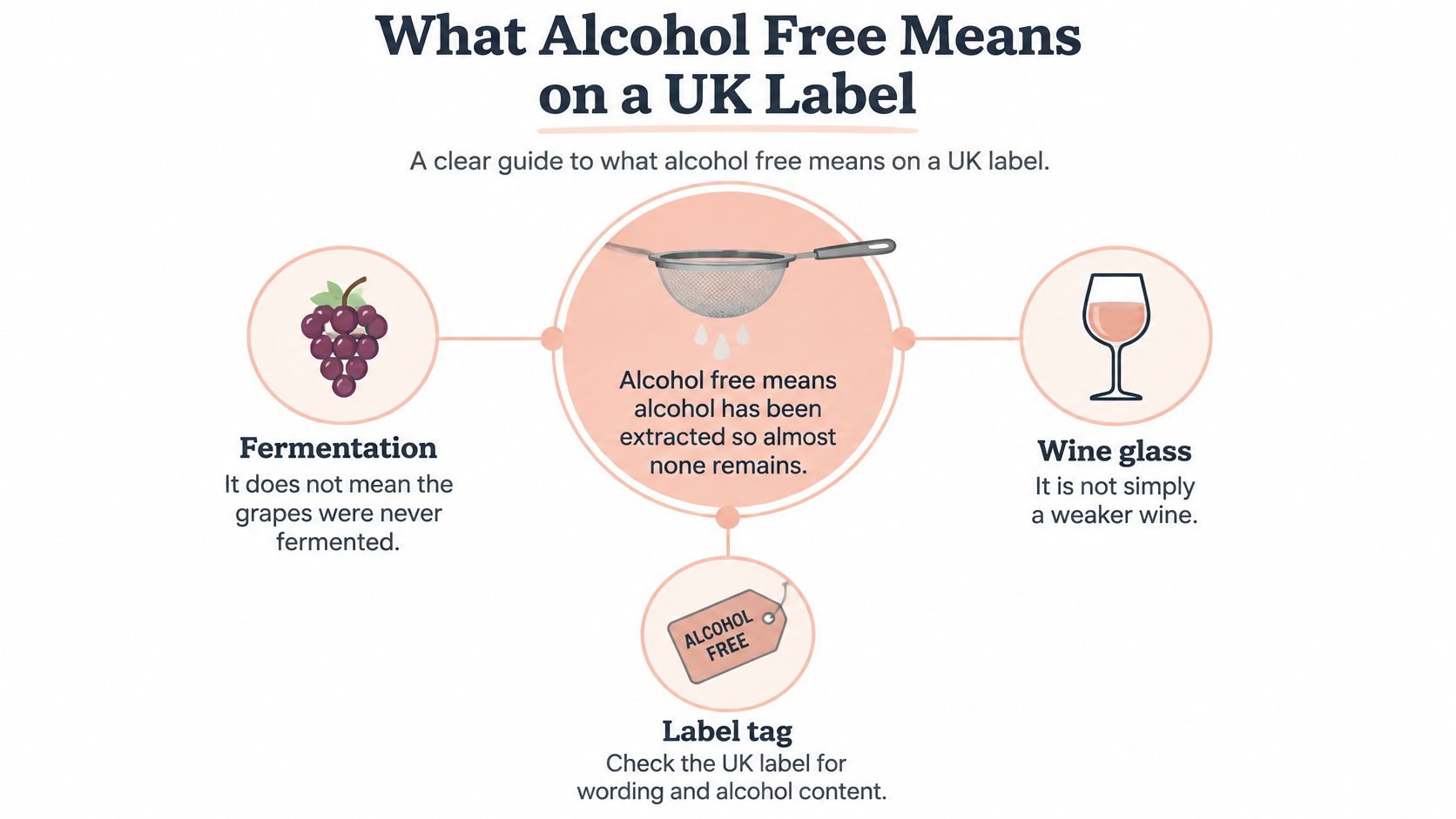
Think of a kitchen sieve: you're separating something from a mixture rather than starting again with different ingredients. Alcohol extraction is much more complex, but the analogy helps explain why alcohol-free wine can begin as fermented wine. It doesn't mean the grapes were never fermented, and it isn't a weaker pour.
The UK Government's no-and-low labelling consultation describes alcohol free as no more than 0.05% ABV after extraction, with de-alcoholised drinks above that level and up to 0.5% ABV, and low-alcohol drinks above 0.5% and below 1.2% ABV. Those distinctions matter more than a prominent zero or free on a shopping tile.
UK ABV bands for no and low drinks
| Descriptor | ABV range | Treat as alcohol-free? |
|---|---|---|
| Alcohol free | Up to 0.05% after alcohol extraction | Yes, if the label states ABV or no alcohol |
| De-alcoholised | More than 0.05% up to 0.5% | No for strict avoidance |
| Low alcohol | More than 0.5% and below 1.2% | No |
| Standard wine duty band starts | 1.3% and above | No, and duty treatment changes |
The final row is a tax distinction, not another alcohol-free labelling descriptor. Nor does qualifying for the alcohol-free descriptor guarantee that a drink meets every personal, medical or religious requirement.
Read the declaration, not the impression
For someone who's pregnant, in recovery, taking certain medicines, following religious rules or asking for no alcohol, don't substitute a de-alcoholised bottle without asking. A labelling threshold isn't medical advice or religious certification. When necessary, seek advice from a clinician, pharmacist or relevant faith authority.
The distinction isn't marginal to shopping: a Great Britain market study published in Drug and Alcohol Review found that alcohol-free products accounted for 83% of no-and-low litres sold through the off-trade in 2023. That figure covers the wider drinks category, not wine alone.
Keep the producer's legal product name when making a shopping note, including wine-based drink where used. Then record the exact ABV, grape variety and sweetness description.
Apply the same label-reading habit to accompaniments. Gym Snack's guide can help you compare snacks with simple ingredients, but still check each option separately for vegan suitability and allergens.
Sugar Calories and Sweetness You Can Check
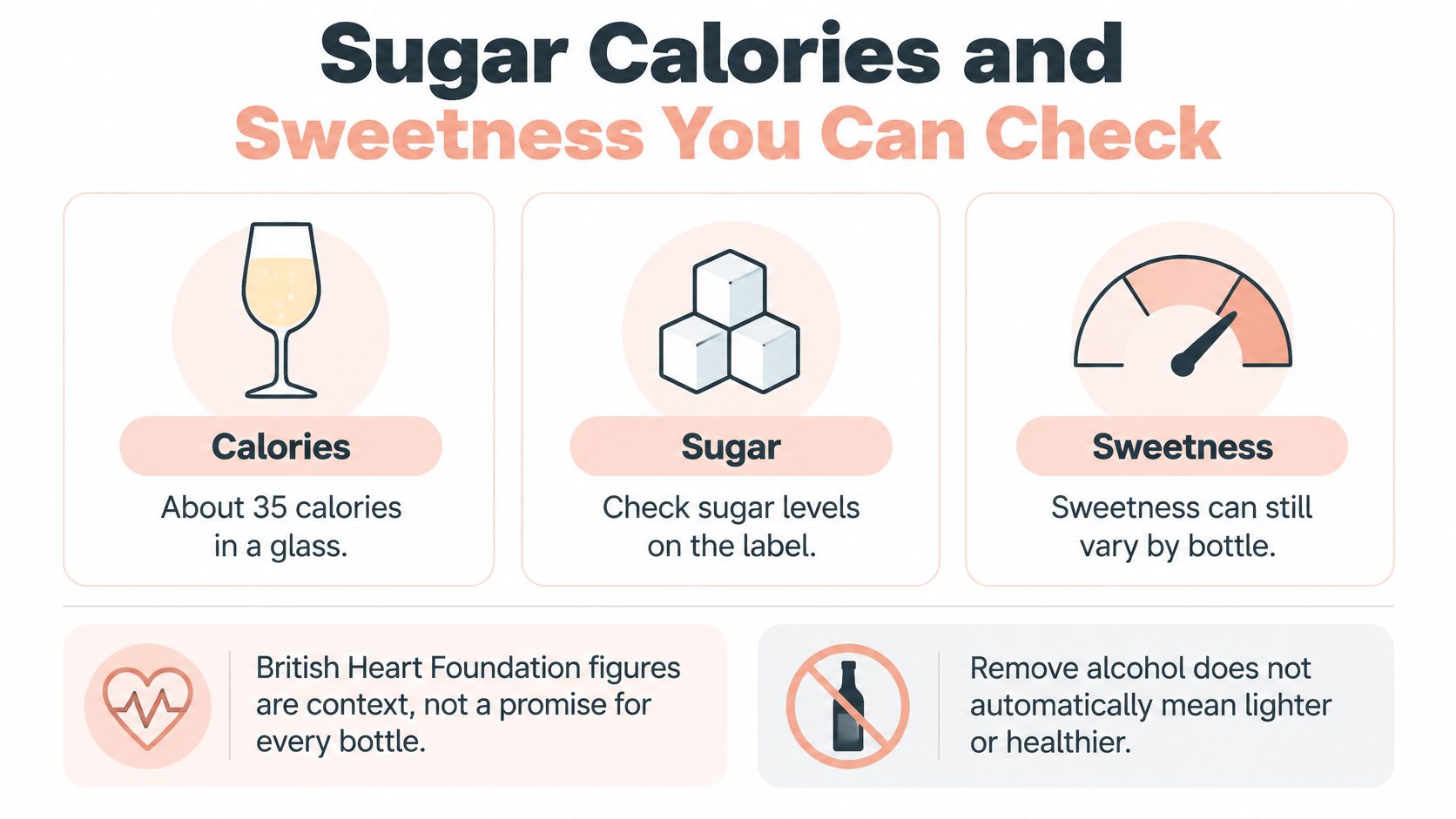
Alcohol-free doesn't automatically mean low-sugar or healthy. Removing alcohol can reduce calories, but it doesn't tell you how much sugar remains or how large your pour will be.
For context, the British Heart Foundation's guide to non-alcoholic drinks gives approximately 35 calories for a glass of zero-alcohol sparkling versus 75 for prosecco, and 30 for alcohol-free red versus 90 for standard red. These are illustrative comparisons, not promises for every bottle; the conventional wine categories below are nutritional references, not product recommendations, and any bottle you select should be confirmed vegan.
Calories in a typical glass
| Drink | About calories per glass | What still varies |
|---|---|---|
| Zero-alcohol sparkling | 35 | Sugar and serving size |
| Prosecco | 75 | Brand and pour |
| Alcohol-free red | 30 | Residual sugar |
| Standard red | 90 | ABV and pour |
The useful distinction is between fewer alcohol-derived calories and less sugar. A drink can offer the former without meeting your expectations for the latter.
Compare like with like
Start with grams of sugar per 100 ml, then check the serving size used for the calorie declaration. Comparing one bottle's small serving with another bottle's larger serving can make the difference look more impressive than it is.
Residual grape sugar can remain after alcohol extraction. Without alcohol's contribution to the balance, that sweetness may also be more noticeable, so your palate and the nutrition panel answer different questions.
- Brut or extra brut: Useful first search terms if you prefer drier sparkling drinks, but not substitutes for checking sugar.
- Dry or off-dry: Helpful flavour clues when choosing a white or rosé for food.
- Medium or sweet: A reason to examine the nutrition information carefully rather than assuming alcohol-free means light.
- Red styles: Check the panel even when the tasting description emphasises berries, oak or richness.
Treat sweetness wording as a clue to flavour, and the nutrition panel as the place to compare sugar.
A wine that tastes sharp can still contain sugar because acidity affects how you perceive sweetness. Equally, fruity aromas don't necessarily mean a sugary drink.
This is general buying guidance, not medical advice. If you're monitoring blood glucose or following a prescribed dietary plan, use the product's nutrition information and your healthcare professional's advice rather than the alcohol-free claim.
Photograph this short note before shopping:
ABV: the exact declaration.
Sugar per 100 ml: the comparable figure.
Sweetness word: brut, dry, off-dry, medium or sweet.
Flavour Cues and Board Pairings
Alcohol acts a little like a cushion in wine, contributing body and helping carry aroma. Remove it and the remaining fruit, acidity, sweetness and tannin have to balance differently. That's why a familiar grape name doesn't guarantee a familiar drinking experience.
A technical review in Food Reviews International explains that membrane and vacuum-based treatments can retain many phenolic compounds while changing acidity, sulphur dioxide, sugar concentration, colour and astringency; it also reports one study in which overall quality scored 4.2 ± 2.5 for alcohol-free wine, 6.6 ± 2.0 for the original and 5.9 ± 1.6 for partially dealcoholised wine. That's a result from one study, not a verdict on every bottle, but it explains why alcohol removal can create a quality gap.
Judge the drink in your glass rather than expecting a medal or zero claim to settle the question. A lighter wine can still be delicious if its flavours feel complete.
Taste for balance before building the board
Use a small pour and notice what happens after you swallow, not just the first burst of fruit.
- Aroma that lasts: Look for a clean grape or fruit aroma that remains noticeable beyond the first sip.
- Refreshing acidity: Freshness should invite another sip, rather than leave an aggressively sour impression.
- Fruit around the tannin: Red styles need enough fruit character to balance a drying sensation.
- A satisfying finish: Avoid a drink that starts pleasantly but ends watery, sticky or abruptly sugary.
- Dry-tasting bubbles: In sparkling styles, check whether the finish matches the dryness you wanted.
Chill the bottle, taste it alone, then take a bite of cheese and taste again. Let a little of the drink lose its initial fridge chill and repeat the comparison. You're checking whether the pairing improves both parts, not whether the wine impresses in isolation.
At the table: If a cheese makes the wine taste bitter, change the pairing before deciding the whole bottle is a disappointment.
Sparkling and crisp white with creamy cheeses
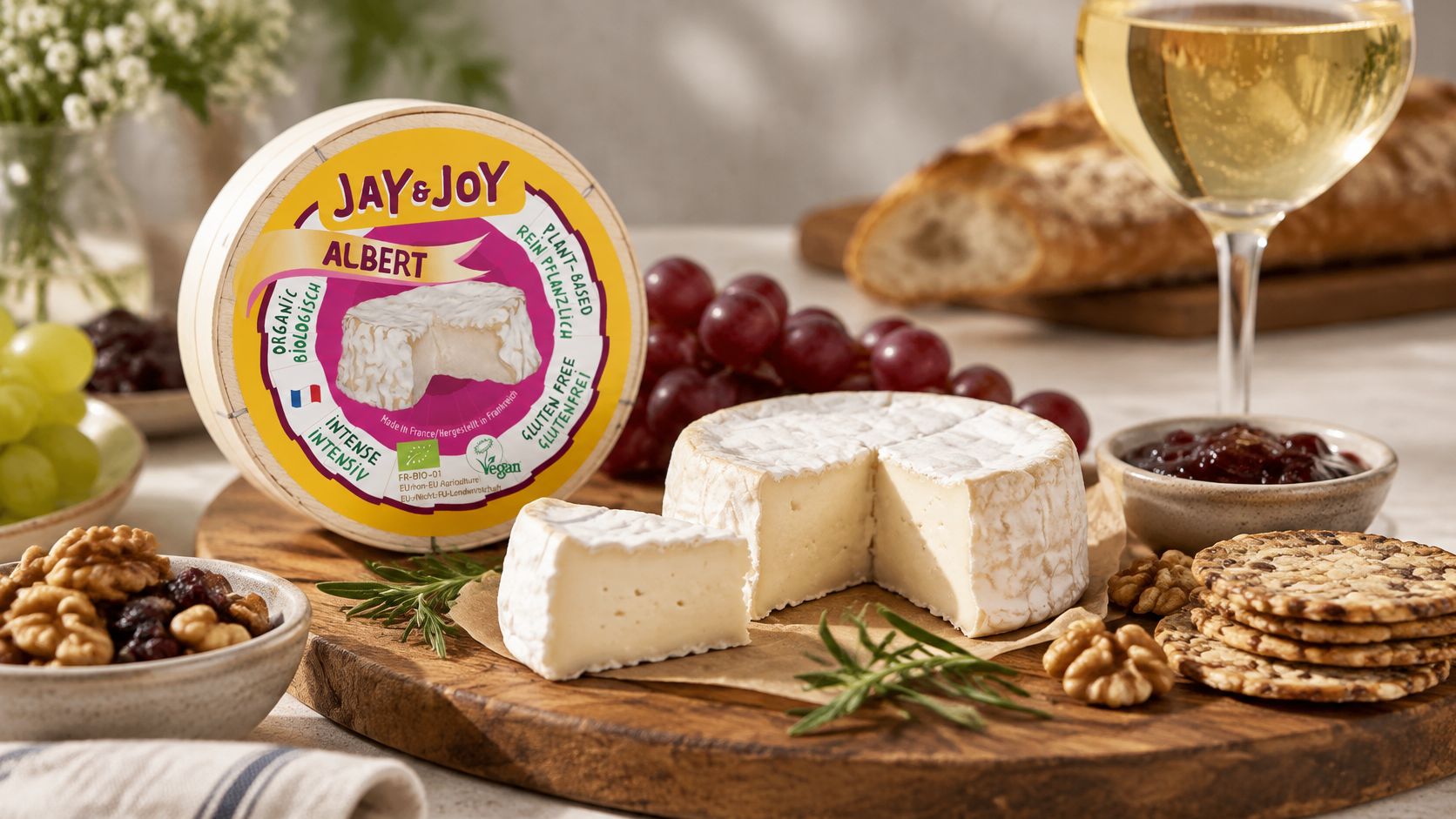
Build this board around a soft Camembert-style or Brie-style vegan cheese, plain crackers and a sharp chutney. The refreshing drink contrasts with the creamy texture, while restrained accompaniments leave room for delicate aromas.
Albert Camembert 100g is a vegan alternative made from organic cashews and almonds, with a bloomy white rind, soft interior and delicate earthy flavour. Those characteristics make it a useful example of the creamy style to try alongside a crisp white.
Keep the chutney in a separate dish. A generous spoonful can dominate a subtle wine, so let guests control the balance.
Aromatic white and rosé with lighter grazing
For aromatic white, combine feta-style plant-based cubes, olives, pickles and herby crackers. A little off-dry sweetness can be pleasant alongside salty or gently spicy bites, provided the drink still tastes fresh.
Don't cover every component in a sharp dressing. Taste the wine with an olive and a cheese cube first, then add the pickles according to preference.
Dry rosé suits a gentler picnic board of mild dairy-free cheese, fresh fruit and a savoury spread. Choose plain crackers or bread as well as flavoured options, so guests can return to a neutral bite between combinations. Keep the fruit separate from the cheese rather than turning the whole board into a sweet pairing.
Fruit-forward red and sweeter styles with stronger bites
For red, choose smoked or firmer nut-based cheeses and look for a drink with clear fruit character. If the wine feels drying, skip bitter rinds and heavily charred accompaniments. A gentler cheese centre may work better than the same cheese with its rind.
Sweeter styles belong with a purpose: blue-style vegan cheese, a very salty bite or a little vegan chocolate. Taste the chocolate alongside the wine before committing to a dessert pairing, because a sweet food can make the drink seem unexpectedly tart.
A mixed vegan cheese collection can provide contrasting textures for a home tasting. Add crackers, chutney, olives and pickles, but leave enough space between flavours to discover which combination you enjoy.
Where to Shop and Which Filters to Use
Start in supermarket and online no-and-low aisles, then try specialist wine retailers when you need more precise filtering. January can be a useful browsing moment: Food Manufacture reported that Ocado's UK alcohol-free drink sales increased by 29% in January 2025. That covers alcohol-free drinks generally, not a winning wine brand.
Specialist tastings and seasonal sampling events can help if you're unsure about flavour. Before booking, ask whether the drinks are vegan and whether the organiser can confirm their alcohol declarations.
Searches you can copy
Use these as starting queries, then inspect the actual results:
- Strict-limit search: vegan alcohol free wine 0.05
- Broader-category search: vegan dealcoholised wine 0.5
- Welcome-drink search: vegan alcohol free sparkling brut
- Nutrition-led search: vegan alcohol free red low sugar
- General search: vegan alcohol free wine
Tick filters in a practical order: UK retail availability, your required ABV, style, sweetness, bottle size, then confirmed vegan suitability. If a shop doesn't provide an alcohol filter, use the product information rather than trusting the category heading.
Vegan confirmation matters because production can involve fining agents that aren't obvious from the grape variety or front label. Organic, natural and premium describe other characteristics; none establishes the alcohol content or guarantees vegan production.
Compare the current shelf, not an old price
Prices move, so compare current GBP prices alongside bottle size, delivery charges and the information supplied. A cheaper listing isn't useful if you can't establish whether the drink meets your requirements.
Tax treatment is separate from retail value. The Government's Alcohol Duty table lists wine at or below 1.2% ABV at £0.00 per litre of pure alcohol, with the next listed wine band beginning at 1.3% ABV. Duty is calculated on pure alcohol, not as a flat bottle charge, and a duty-free category doesn't promise a particular shelf price.
For the food half of the evening, choose an artisan vegan cheesemonger and deli for plant-based cheese, crackers and chutneys rather than assuming it also carries a complete wine range.
Before checkout, use a short checklist:
- ABV confirmed: The declaration meets the guest's stated requirement.
- Sugar checked: The nutrition information suits your comparison.
- Style chosen: The bottle fits the menu.
- Alternative planned: Add a spare choice if guests have different preferences.
Serve It Well and Finish the Evening
Once you've chosen the bottle, keep the serving routine straightforward. You don't need specialist equipment, but temperature, glass shape and a small test pour can make the evening easier.
A calm serving routine
- Chill with the style in mind. Put sparkling and white in the fridge, and give red only a light chill. Taste before serving rather than assuming every red benefits from a warm room.
- Give the aroma space. A white-wine glass is a practical all-rounder. If you're choosing glassware, Everti's guide to larger wine glasses offers useful context on bowl size, but you don't need oversized glasses to enjoy the drink.
- Pour a small taste first. Check that the bottle tastes clean and suits the food before filling everyone's glasses. Let guests decide whether they'd like more.
- Take the chill off soft cheeses. Open them a little ahead of serving so the centres aren't fridge-firm, while following their storage instructions. Keep reserve portions chilled.
- Arrange for easy pairing. Put creamy cheeses near the acid-led drinks and offer milder bites alongside drying reds. Separate chutneys and pickles let guests adjust each mouthful.
- Offer something that isn't wine. Sparkling water or another clearly labelled drink gives guests a genuine choice. If considering Lucky Saint alcohol-free lager, verify the current vegan and ABV information against their requirements rather than treating an alternative category as automatic approval.
- Store the remainder carefully. Recork opened still bottles, refrigerate them and follow the producer's after-opening instructions. Use an appropriate sparkling stopper for bubbles, and check aroma and freshness before serving again.
Keep the finish relaxed
Leave water on the table and don't make anyone explain why they're declining a drink. If the pairing isn't working, offer a different cheese or a different beverage without turning it into a test.
For a gift, a cheese selection with crackers and chutney can be easier to personalise than an unverified bottle. A gift card also lets the recipient choose around their own dietary needs.
Saporia is an artisan UK vegan cheesemonger and deli offering plant-based cheeses, cheese bundles and accompaniments for a thoughtful board. Choose your wine style and check its label, then visit Saporia to put together the creamy cheeses, crackers, chutneys, olives and pickles to enjoy alongside it.