

What Do Vegans Eat: A Practical UK Food Guide
You open the fridge, spot a sad half onion, some carrots, maybe a tub of something you bought with good intentions, and ask the question almost every newcomer asks sooner or later, what do vegans eat? The short answer is that vegans eat ordinary food, just arranged differently, with plant foods doing most of the work and fortified foods filling the gaps where needed. In the UK, that usually means meals built from beans, pulses, grains, vegetables, fruit, nuts, seeds, and fortified plant alternatives, with vegan cheese playing a flavour role rather than pretending to be the whole diet.
Table of Contents
- The Building Blocks of a Vegan Plate
- Core Food Groups Vegans Rely On
- A Realistic Day of Vegan Meals and Snacks
- Key Nutrients and How to Cover Them
- Shopping Smart on a UK Vegan Budget
- Common Myths Worth Putting to Rest
- Eating Out, Travelling and Entertaining
- Quick Answers and What to Try Next
The Building Blocks of a Vegan Plate
Start with the fridge, not the label
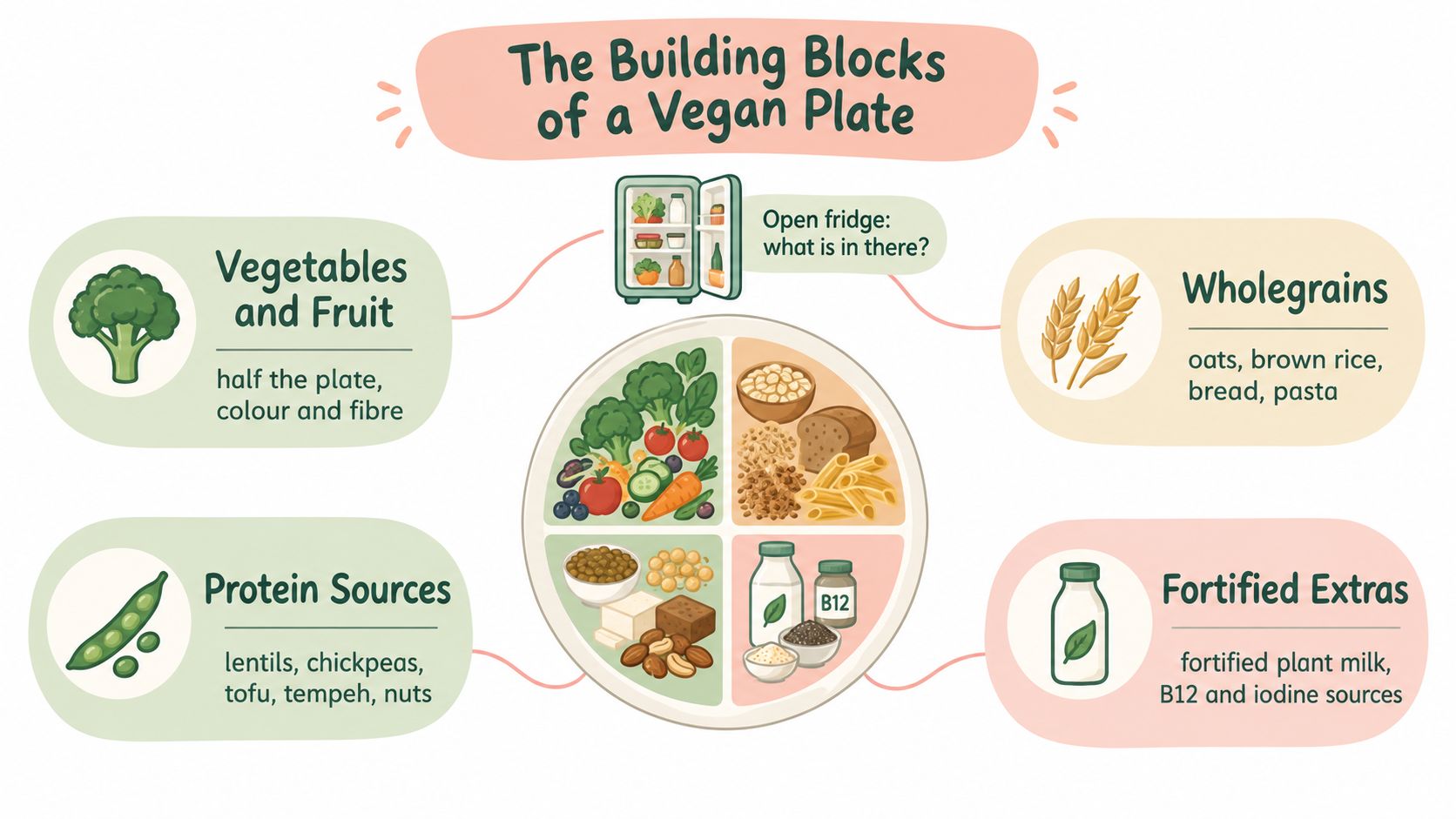
If you're staring into an open fridge, the easiest way to think about vegan eating is to stop looking for replacements and start looking for roles. Every plate needs something filling, something colourful, something starchy, and something that adds flavour or richness. Once you see it that way, vegan food stops feeling mysterious and starts feeling practical.
The foundation is usually a protein food, often from pulses or soya-based ingredients. In UK research, vegans ate more beans and pulses than meat-eaters on average, and they also reported more fruit and vegetables each day, which shows how central those foods are to everyday vegan eating in Britain (PMC analysis of UK participants). That doesn't mean every meal has to look the same. It means a lunch of lentil soup, wholegrain bread and salad makes as much sense as a dinner of tofu, rice and stir-fried greens.
Practical rule: build the plate around one sturdy plant protein, one starchy base, and at least one generous portion of vegetables.
The four parts that make meals work
A simple vegan plate often has four moving parts. First, pulses and plant proteins, such as lentils, chickpeas, beans, tofu, tempeh, nuts and seeds. Second, vegetables and fruit, which bring fibre, colour and freshness. Third, wholegrains and starchy staples, like oats, bread, rice, pasta, potatoes and other everyday carbs. Fourth, fats and fortified extras, which include oils, seeds, fortified plant milk, and sometimes vegan cheese for taste and texture.
That last group matters because not every vegan food is meant to be a nutritional anchor. Some items exist to make food feel complete, social and enjoyable. A slice of vegan cheese on toast, a spoon of chutney, or a handful of olives can turn a plain plate into something that feels like a proper meal without pretending to be the main source of protein or vitamins.
For a broader look at how dense foods fit into everyday eating, you can also explore the powerhouse food list. Think of it as a useful mindset shift, not a shopping rule. Vegan eating works best when you treat the fridge as a set of building blocks, then combine them in ways that are filling, varied and easy to repeat.
Core Food Groups Vegans Rely On
What shows up most often on a real shop
A vegan shop basket in the UK usually starts with a few dependable groups, then builds meals around them. UK evidence shows that vegans do not rely on just one or two “special” foods, they use familiar staples, especially pulses and produce. In one analysis of UK participants, vegans ate more beans and pulses on average than meat-eaters, and they reported more fruit and vegetables each day too. That matches what you see in ordinary cupboards, fridges and lunchboxes.
Beans, lentils and chickpeas do a lot of the heavy lifting. They show up in soups, stews, curries, fillings and spreads, the way a good deli counter keeps returning to the same reliable base and changing the seasoning.
Tofu and tempeh fill another job. They work well in stir-fries, sandwiches and quick dinners, and if you are new to tofu, this plain organic tofu option is the kind of ingredient that slips into simple meals without much fuss.
Nuts and seeds bring crunch, extra richness and an easy snack option. Wholegrains such as oats, brown rice and wholewheat bread add structure and help a meal feel complete. Vegetables and fruit bring freshness, texture and colour, which is why a vegan plate rarely stays dull for long.
Fortified extras sit in a different lane. Plant milks, yoghurts and some vegan cheeses can add convenience, taste and, when fortified, specific nutrients. They are not there to replace the rest of the plate, they make everyday eating easier to repeat.
Some vegan meals are built from scratch. Others are built from the cupboard, a bag of salad leaves and one good spread.
Where artisan extras fit in
Deli-style extras have a real place here. Vegan cheese, crackers, chutneys, olives and pickles do not stand in for pulses or greens, they make the meal more satisfying. A chickpea sandwich feels sharper with pickle. Brown rice needs sauce or seasoning. A cheeseboard works because the cheese sits beside crunch, sweetness and saltiness.
That is why “what do vegans eat” is the better question than “what do vegans substitute?”. The answer is a pattern of meals built from familiar foods, plus a few carefully chosen extras that make the whole thing enjoyable enough to keep coming back to.
A Realistic Day of Vegan Meals and Snacks
Breakfast that doesn't feel like a project
A normal vegan day doesn't need constant cooking. Breakfast can be as simple as oats with fruit and seeds, or a jar of overnight oats made the night before. The point is to start with something that gives you steadier energy than a pastry and doesn't ask for much effort before work.
If you like a ready-made shortcut, Apple & Cinnamon Protein Overnight Oats 400g is an example of a breakfast format that fits a busy morning, combining wholegrain oats with protein and seeds in a chilled, spoonable meal. That kind of product works because it behaves like a breakfast, not a snack pretending to be one.
Lunch, dinner and the bits in between
Lunch can be a chickpea salad sandwich, lentil soup with bread, or leftovers from last night's dinner. Dinner might be tofu with noodles and vegetables, bean chilli with rice, or a traybake with potatoes and roasted veg. None of that needs to feel elaborate. Vegan eating often works best when you repeat a few reliable formulas and change the flavour through herbs, sauces or a different spread.
Snacks are just as normal. Fruit, nuts, crisps, hummus with veg, a handful of chocolate, or a small plate with crackers and a savoury spread all fit neatly into the day. Coffee with plant milk is part of the picture too, as is tea, water, and whatever keeps you going between meals.
A vegan day usually feels ordinary, not restrictive, once you stop expecting every meal to be a new recipe.
For something slightly more substantial at lunch or after the gym, it helps to combine oats, seeds and protein-rich ingredients instead of relying on fruit alone. The same logic applies at dinner. If the meal feels too light, add beans, tofu, lentils, nut butter, or a sauce made with tahini or seeds. That's the difference between a vegan meal that looks nice and one that carries you through the afternoon.
Key Nutrients and How to Cover Them
The nutrients that need deliberate attention
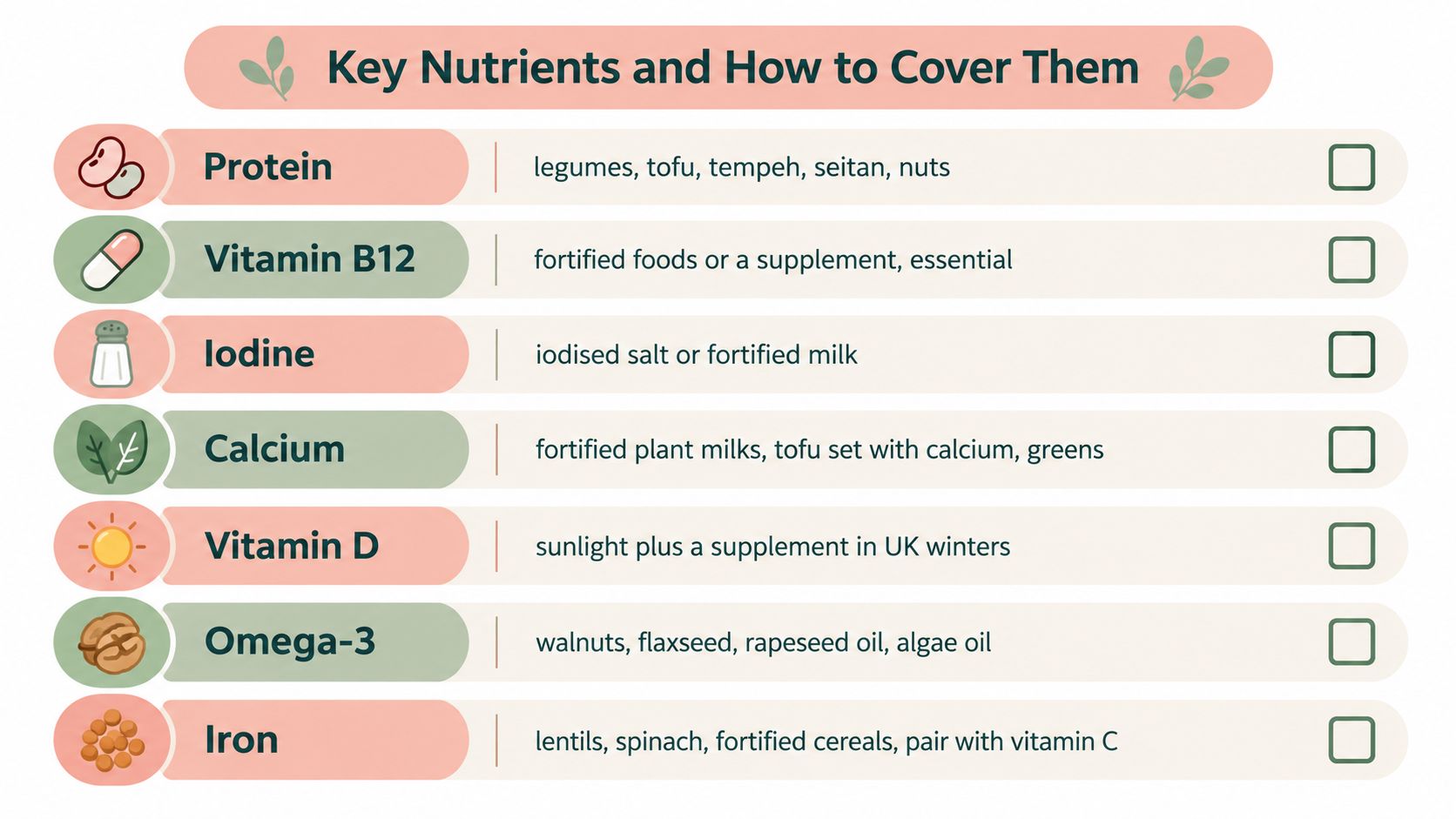
A well-planned vegan diet is built around variety, but a few nutrients deserve extra attention in the UK. Vitamin B12 is the clearest example. Reliable vegan sources are fortified foods and supplements, including fortified breakfast cereals, yeast extracts, soya yoghurt and fortified plant-based dairy alternatives (British Dietetic Association guidance). That's why some plant milks and yoghurts matter more than others, the label is doing real work.
Iodine needs a closer look too. Research among vegans, vegetarians and omnivores in Nottingham found that vegans had the lowest iodine intake in both periods studied, with a median of 47.6 micrograms per day in 2016–2017 and 17.3 micrograms in 2019, compared with a UK reference intake of 150 micrograms (Nottingham iodine study). That's why iodine is one of the nutrients vegans shouldn't leave to chance.
What to look for on labels
Calcium, vitamin D and omega-3 also need some planning. Calcium can come from fortified plant drinks and yoghurts, tofu set with calcium, beans, sesame, almonds and leafy greens. Omega-3 can come from walnuts, flax, chia, hemp and rapeseed oil, with algae-based supplements as a direct vegan source of the longer-chain fats. For vitamin D, the NHS advises adults to consider 10 micrograms daily from October through March because dietary sources are limited across the population (NHS vegan diet guidance).
That means label-reading becomes a habit, not a chore. Check whether a product contains B12, iodine, calcium and vitamin D before assuming it does. A vegan cheese might be lovely on crackers, but unless it's fortified, it's there for taste and texture, not as a complete nutritional package.
For readers who want a simple shopping lens, browse plant-based protein sources and compare them against the foods already sitting in your own kitchen. The takeaway is simple. Fortified foods and supplements are part of normal vegan infrastructure in the UK, alongside beans, tofu, grains, vegetables and fruit.
Shopping Smart on a UK Vegan Budget
Build the basket around cheap, steady foods
Affordability shapes how people eat. The UK Government's 2025 Food Security Digest reports that 91% of respondents in England, Wales and Northern Ireland were concerned about food prices, and it also cites research showing that the poorest fifth would need to spend 45% of disposable income to afford the Government-recommended healthy diet, rising to 70% for households with children (UK Government Food Security Digest 2025). That's exactly why vegan eating should be explained in budget terms, not just in ideal meal photos.
The affordable core usually comes first. Dried lentils, tinned beans, oats, potatoes, bananas, frozen vegetables, rice, pasta and bread can do most of the heavy lifting. Once those are in place, the rest of the basket can be treated as flavour or convenience rather than necessity.
| Category | Examples | Role in the Diet |
|---|---|---|
| Affordable staples | Oats, lentils, beans, potatoes, rice, frozen veg | Daily nourishment, filling meals, batch cooking |
| Flavour-led extras | Vegan cheese, crackers, chutneys, olives, chocolate | Taste, variety, entertaining, occasional treats |
| Fortified items | Plant milks, yoghurts, breakfast cereals | Nutrient support where labels confirm fortification |
Where a deli-style shop makes sense
If you're trying to keep costs sensible, premium items work best as add-ons. A small wedge of vegan cheese can turn bread, soup or a baked potato into something more satisfying, but it doesn't need to dominate the weekly basket. The same goes for chutney, pickles and crackers. They matter most when you're building a shared board or making lunch feel less repetitive.
For a more filling base, a simple grain dish does a lot of work. Organic Basmati Brown Rice 1kg is the kind of cupboard staple that stretches across multiple meals, from stir-fries to grain bowls to leftovers. When you combine a low-cost base with legumes and seasonal vegetables, vegan eating stops looking like a special purchase and starts looking like normal cooking.
The useful rule is this. Staples carry the nutrition, extras carry the enjoyment. That's how budget, flavour and practicality stay in balance.
Common Myths Worth Putting to Rest
Protein worries usually come from old assumptions
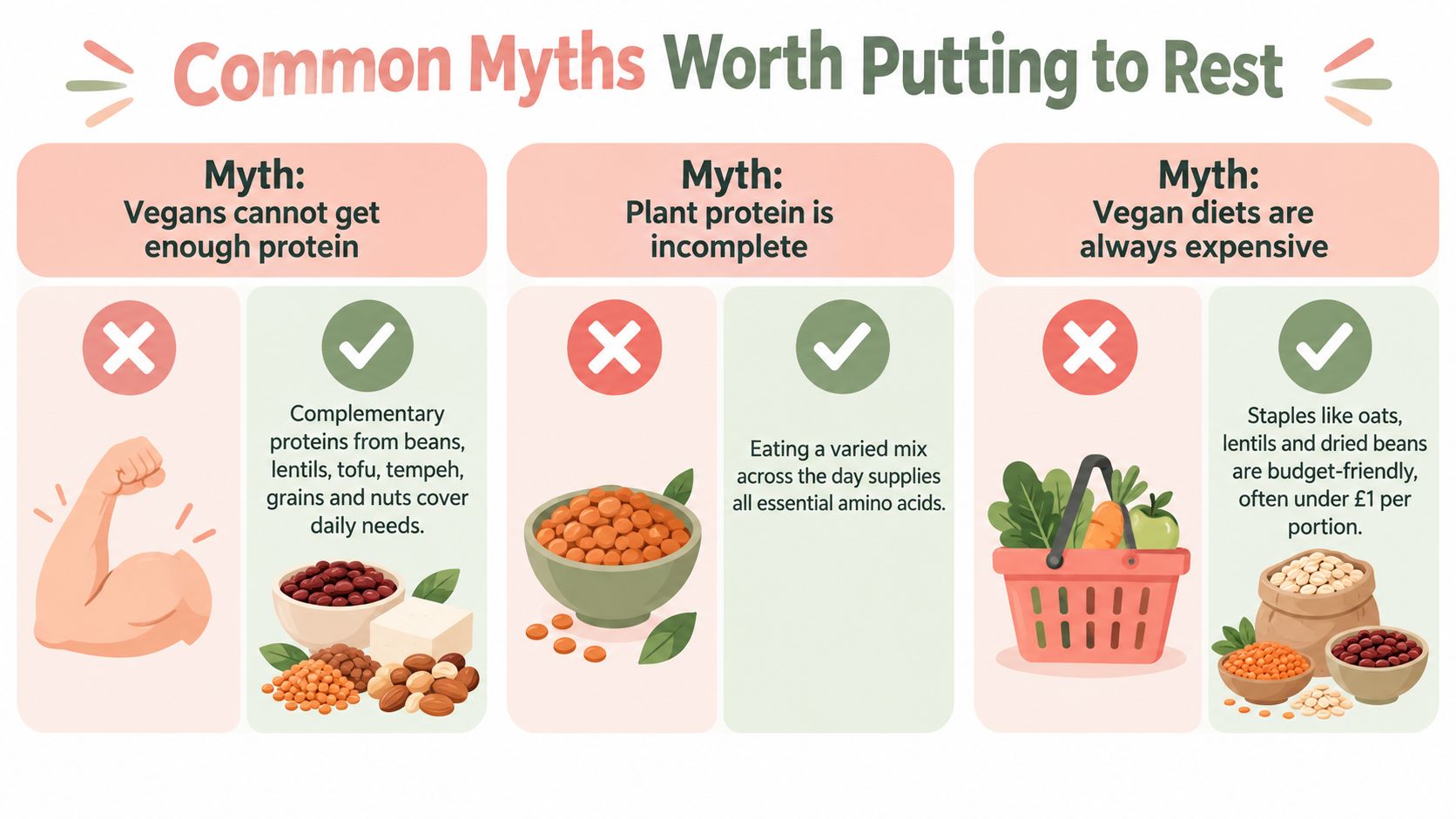
The biggest myth is that vegan eating cannot deliver enough protein. Once a plate includes beans, lentils, tofu, tempeh, grains, nuts, and seeds, that worry usually fades. A bowl of lentil pasta, a chickpea curry with rice, or peanut tofu with noodles all cover the job neatly. Protein works best as part of the whole meal, not as a single food to chase.
Another myth says plant protein is incomplete by default. That is too neat to be useful. Variety across the day matters more than forcing every meal to contain every amino acid in isolation, and most everyday vegan meals already mix more than one source.
Vegan does not automatically mean healthy
The second myth is that all vegan diets are automatically healthy. UK dietary-pattern research identified convenience, health-conscious, unhealthy, and traditional-vegan patterns, which is a polite way of showing that vegan food can range from whole-food meals to heavily processed convenience eating (PMC analysis of UK participants). A packet of vegan biscuits and a tub of meat-free substitutes may fit a vegan label, but they do not create balance on their own.
Healthy vegan eating is built, not assumed. The foods matter more than the label on the front.
The third myth is that vegan cheese should match dairy cheese nutritionally. It is not a direct one-to-one swap, and it does not need to be. Its main role is flavour, texture, and making a meal feel complete. The nutrition still comes from the wider plate, with fortified foods, pulses, tofu, leafy greens, and supplements where needed.
Affordability shapes how people eat. That is why budget, texture, and convenience all influence what ends up on the table, not just the word “vegan” on the packet.
Eating Out, Travelling and Entertaining
Make the meal plan work outside your kitchen
Eating out gets easier when you stop asking whether a menu is “vegan” and start asking what can be built from sides, swaps and simple dishes. Many places can manage a jacket potato, pasta, rice bowl, soup, salad or flatbread once you know to ask clearly. Travelling works the same way. Pack a snack, carry a sandwich, and keep a few emergency bits in your bag so you're not relying on chance.
For entertaining, the easiest win is a small plant-based board that feels generous without being complicated. Use two or three vegan cheeses, a seeded cracker, a sweet chutney, and a few olives or pickles. If you want a fuller spread, add grapes, nuts, sliced cucumber and a simple dip. The board looks thoughtful because the flavours and textures balance each other.
A good rule is to separate the food into roles:
- Base items such as bread, crackers or breadsticks.
- Creamy or savoury items such as vegan cheese or a spread.
- Sharp or sweet accents such as chutney and pickles.
- Fresh or crunchy items such as fruit, cucumber or celery.
Saporia runs cheese and wine tasting evenings at The Cheese Cellar in collaboration with Purezza Camden, including fondue nights on Thursday to Saturday, offering an in-person way to sample artisan vegan cheeses before buying. That kind of experience helps when you're still learning which styles you like, especially if you want to understand how cheese behaves with crackers, fruit or preserves before you build your own board at home.
If you're hosting a lunch, picnic or casual evening, keep it simple. A few good components beat a sprawling table of unrelated bits every time. The goal is not to imitate a dairy board exactly, it's to serve food that feels easy to share and pleasant to eat.
Quick Answers and What to Try Next
A few things people ask right away
Can children and teenagers eat vegan food safely? Yes, but it needs the same care as any family diet, with attention to variety, fortified foods and supplements where needed. The central idea is not restriction, it's planning.
Do vegans only eat specialist products? No. Most vegan meals are built from ordinary foods such as beans, oats, potatoes, rice, vegetables and fruit. Specialist products are optional extras, not the whole story.
Is vegan cheese supposed to replace dairy cheese nutritionally? Not really. It's better treated as a taste and texture food, then paired with legumes, fortified drinks, vegetables and wholegrains for the rest of the meal.
If you're still deciding what suits your routine, start with the basics that do the heavy lifting, then add the more indulgent bits where they help. Browse Saporia's vegan cheese, bundles, crackers, chutneys, gift cards and new arrivals when you want ideas for meals, entertaining or gifting. The right plant-based food doesn't need to feel complicated, it just needs to fit your day.
If you'd like to turn this into a cheeseboard, a weeknight dinner plan or a vegan gift, visit Saporia and browse the current range. You'll find plant-based cheeses, accompaniments and tasting ideas that make everyday vegan eating feel easier, warmer and a lot more enjoyable.