

Alcohol Free Wine UK: Labels, Flavours and Where to Buy
If a bottle says alcohol-free, why should you still check its alcohol content before thinking about flavour? Because the wording on the front doesn't always tell you everything you need to know, especially if you're avoiding alcohol rather than drinking less.
Choosing alcohol-free wine in the UK becomes easier when you start with the printed ABV, then think about what you'll eat alongside it. A lively sparkling style and a soft vegan cheese might make a lovely match, while the same drink could feel too sharp with a punchy blue-style cheese. Understanding labels, production and flavour gives you a better starting point than a list of supposedly perfect bottles.
Table of Contents
- Understanding UK Alcohol-Free and Low-Alcohol Labels
- How Alcohol-Free Wine Is Made and Why Taste Changes
- Flavour Styles to Expect from Alcohol-Free Wine
- Pairing Alcohol-Free Wine with Vegan Cheese
- Choosing, Buying and Storing Your Bottle
- Serving and Tasting Alcohol-Free Wine at Home
- Common Questions About Alcohol-Free Wine
Understanding UK Alcohol-Free and Low-Alcohol Labels
What does the ABV on a bottle tell you? ABV means alcohol by volume, and it is the first detail to check when deciding whether a drink fits your needs.
The UK government's no- and low-alcohol labelling guidance uses “alcohol-free” for drinks containing no more than 0.05% ABV and “de-alcoholised” for drinks containing up to 0.5% ABV. Labels should state the ABV or clearly indicate that the drink contains no alcohol.
UK alcohol labels by ABV
The low-alcohol description and the alcohol-duty threshold answer different questions. HMRC's Alcohol Duty guidance says drinks at 1.2% ABV or below are not subject to Alcohol Duty.
| Label term | Maximum ABV | What to check on the bottle |
|---|---|---|
| Alcohol-free | No more than 0.05% | ABV stated or a clear no-alcohol statement |
| De-alcoholised | Up to 0.5% | ABV printed and wine-based descriptor where required |
| Low alcohol | 1.2% for the duty-free threshold | ABV printed; duty-free does not mean zero alcohol |
| Standard wine | No reduced-alcohol maximum | Declared ABV, used as your comparison baseline |
A tax category tells you about duty, not how much alcohol is in the glass. For strict abstinence, check the bottle's stated ABV and product details rather than relying on a prominent claim on the front.
Practical rule: Decide what alcohol level suits you before weighing up grape variety, bottle design or tasting notes.
Why the description can look unfamiliar
Government guidance on no- and low-alcohol labelling explains that wine with alcohol removed cannot currently be sold as wine in Great Britain. Its label may instead describe it as a wine-based drink, alongside ingredients and other food-labelling information.
That description reflects how the product is labelled. It does not tell you whether the drink tastes balanced, dry or enjoyable.
Use this routine when checking a bottle:
- Find the ABV. Look beyond the largest wording on the front.
- Read the product description. Alcohol-free and de-alcoholised have different meanings.
- Match the ABV to your needs. Cutting back and avoiding residual alcohol are different requirements.
- Resolve missing details. Ask for the packaged label or supplier specification rather than guessing.
Online product pages should make the ABV easy to find. If it is unclear, get that detail before ordering.
How Alcohol-Free Wine Is Made and Why Taste Changes
For a de-alcoholised product, the starting point is fermented wine. The producer then removes ethanol, aiming to preserve as much aroma and structure as possible.
Ethanol contributes to body, aroma transport and perceived sweetness, so taking it out changes more than the alcohol content. A technical review of wine dealcoholisation describes vacuum processing at approximately 100–120 mbar and 30–40°C, helping limit heat damage; it also reports a perceived sweetness reduction equivalent to about 25 g/L of residual sugar in one technical account.
That sweetness comparison doesn't mean every producer removes that amount of sugar. It illustrates how differently a drink can taste when its alcohol is removed.
The methods in plain English
Vacuum distillation lowers pressure so alcohol can be removed at a lower temperature. Spinning-cone columns separate volatile components in stages, allowing producers to handle aromas separately from alcohol.
Reverse osmosis uses fine membranes to separate components before further processing and blending. Other membrane-based approaches include pervaporation, osmotic distillation and diafiltration, which use different separation or washing processes to reduce ethanol.
These are alternative production routes, not stages that every bottle passes through.
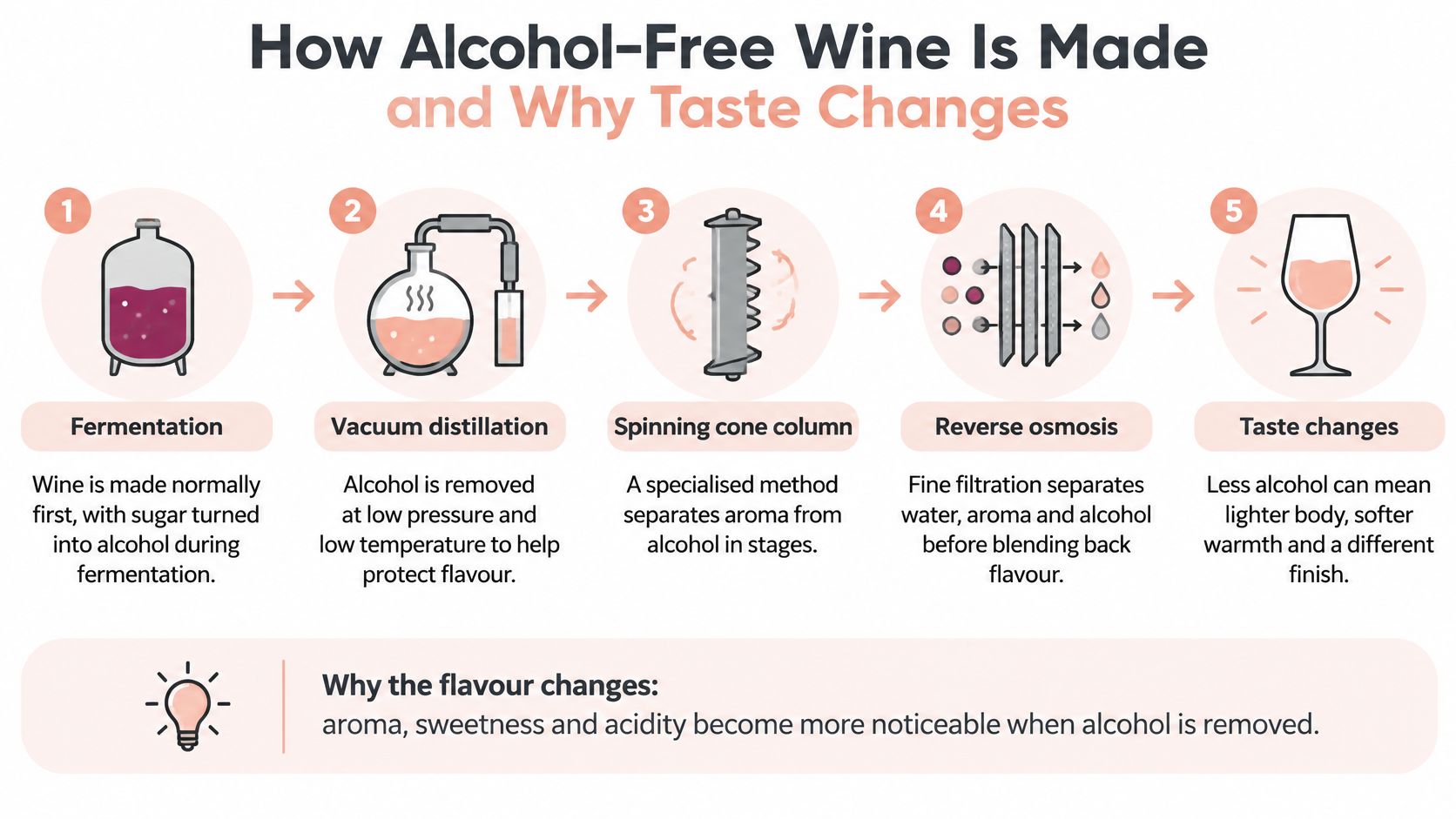
From fermentation to the finished bottle
- Ferment the base wine. The producer establishes its initial fruit, acidity and structure.
- Remove alcohol. A suitable separation method reduces ethanol.
- Manage the aromas. Where the process allows, captured aromas can be returned.
- Balance the drink. Sugar and acidity may need adjustment to suit its lighter structure.
- Bottle and label. The finished product needs its own specification and serving guidance.
Removing alcohol can leave a drink feeling thinner, less sweet or more noticeably acidic. Producers may compensate through aroma recovery, careful blending or choosing a style that works with a lighter body.
Good production isn't only about achieving a low reading. For the drinker, the useful question is whether the finished combination of aroma, sweetness, acidity and texture feels coherent.
Flavour Styles to Expect from Alcohol-Free Wine
Sparkling is a useful starting point, although popularity isn't a guarantee of personal preference. According to Kantar figures reported by The Drinks Business, UK spending on non-alcoholic sparkling wine rose 3.5% in the 52 weeks to 20 April 2025, while spending on non-alcoholic still wine fell 1.8%.
Bubbles give a drink another source of texture, which can make a lighter body feel more complete. Still styles offer a different experience, with fruit, acidity and finish more exposed.
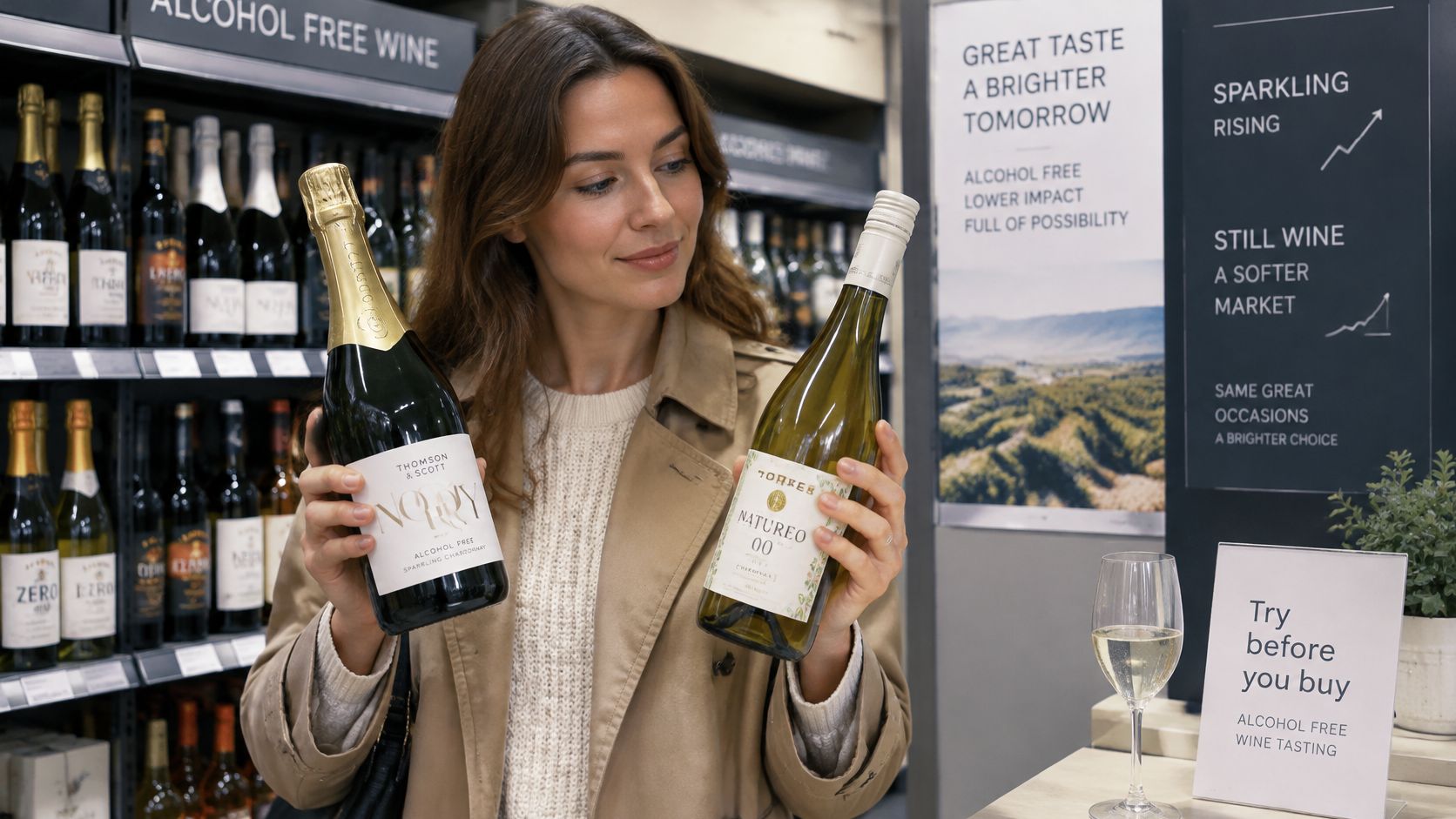
Compare the style, not just the colour
These are useful flavour expectations rather than promises about every bottle. Choose a verified vegan option within your preferred style.
| Style | What you might notice | A useful first occasion | Check before choosing |
|---|---|---|---|
| Sparkling | Lively bubbles, crisp acidity and a brisk finish | An aperitif before dinner | Whether it's dry or noticeably sweet |
| White | Light to medium body, clean fruit, sometimes gentle sweetness | A fresh lunch or simple cheeseboard | Acidity and sweetness balance |
| Rosé | Light fruit, berry notes and a refreshing finish | A picnic or relaxed outdoor meal | Whether the fruit tastes fresh or confectionery-like |
| Red | Lighter body than expected, with sometimes prominent tannin | A mild, savoury plant-based dish | Smoothness rather than colour depth |
| Sweet or dessert-style | Richer sweetness and a fuller, sometimes syrupy texture | A small serving alongside salty vegan cheese | Whether the finish remains balanced |
A crisp, dry white is an approachable first try if you enjoy clean, refreshing drinks. Rosé can suit someone who prefers gentle fruit, while red needs more careful selection if you're expecting warmth and weight.
Sweetness isn't necessarily a fault. It becomes a problem when it overwhelms the fruit or makes the drink tiring after a few sips.
Give each bottle a fair test
Judge alcohol-free wine on body, sweetness, acidity and finish, rather than expecting an exact copy of a familiar full-strength style. A drink can be enjoyable without reproducing every sensation you associate with wine.
Try contrasting styles and notice which leaves your mouth feeling fresher. Ask whether you'd enjoy another sip with food, not just whether the opening aroma seems familiar.
Choose the first style according to the occasion: dry sparkling for an aperitif, white for a lighter meal, or a smoother red for something savoury. That gives the bottle a clear job to do.
Pairing Alcohol-Free Wine with Vegan Cheese
Start with the cheese, not the bottle. Texture, saltiness, acidity, sweetness and smoke tell you more about a likely match than a familiar wine-and-cheese rule.
A soft, rich cheese needs refreshment between bites. A sharp, salty cheese may need sweetness to soften the contrast, while a delicate spread needs a drink that won't dominate it.
Vegan cheese and alcohol-free wine pairings
Use these as starting points, then adjust to the actual sweetness and acidity of your chosen drink.
| Vegan cheese | Alcohol-free style | Why it works | Watch out for |
|---|---|---|---|
| Camembert-style, soft and creamy | Dry sparkling | Bubbles and acidity cut through richness | Sweet sparkling can feel cloying |
| Smoked | Fuller, fruit-led red | Smoke meets fruit and body | Thin, sweet reds can clash |
| Feta-style, salty and tangy | Crisp, dry white | Salt and acidity match | Heavily sweet wine overwhelms it |
| Blue-style, sharp and rich | Sweet or dessert style | Sweetness balances salt | Dry sparkling can taste sharp |
| Mozzarella-style, mild | Light sparkling or dry rosé | Fresh and gentle | Oaky whites can dominate |
| Ricotta-style, delicate | Delicate still white | Gentle flavours stay balanced | Strong red overpowers it |
The texture match matters as much as the flavour match. With creamy cheese, look for a drink that refreshes your palate; with a crumbly, tangy style, check that the acidity doesn't become abrasive.
A pairing works when you want another bite and another sip. It doesn't have to follow a traditional rule.
For example, try a smoked plant-based cheese with a fruit-led red before adding chutney. If the cheese already makes the drink taste sweeter, a sugary accompaniment may push the combination too far.
Build a board without crowding the flavours
The Almond Mlk Chese Spread Natural 150g is a thick, creamy almond-based alternative with live vegan cultures, British sea salt and a mild, subtly tangy flavour. Its gentle profile makes a delicate white or restrained sparkling style a sensible pairing experiment.
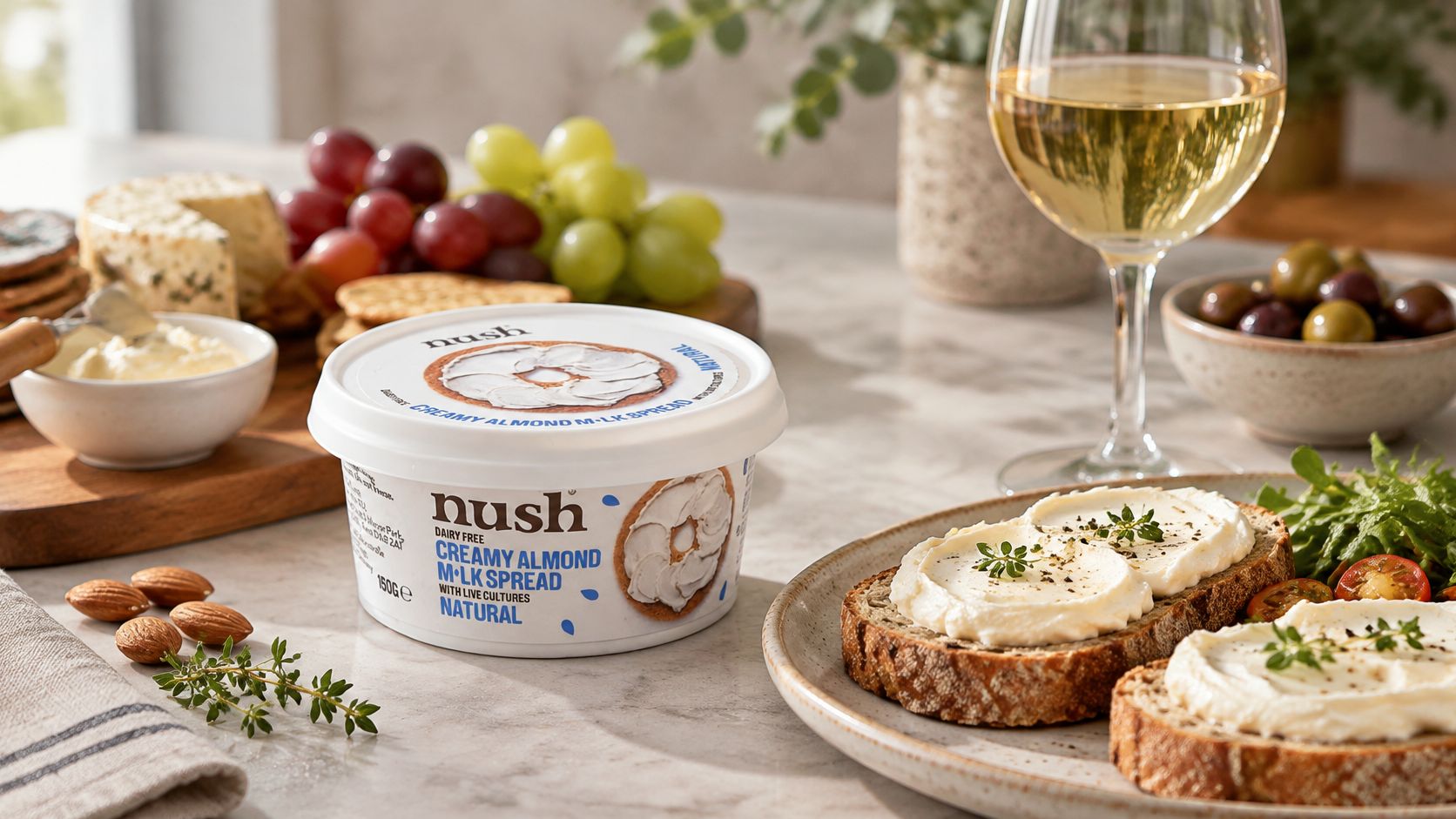
Build around your chosen cheese with plain plant-based crackers, a chutney served separately, and olives or pickles. Keeping accompaniments separate lets guests discover whether it's the cheese, sweetness or brine that changes the drink.
For a selection rather than individual cheeses, explore the La Fauxmagerie bundle, checking its current contents before planning your pairings.
Some combinations disappoint. A tangy kombucha may be more enjoyable with a sharp cheese than a wine-style drink, but check its alcohol specification too if residual alcohol matters to you. Browse the current vegan cheese selection by texture and intensity, and read each product page before buying.
Choosing, Buying and Storing Your Bottle
Start with the label, then consider how the drink will fit your meal. A useful product page should show the packaged label, ingredients, tasting notes and serving information, helping you distinguish a dry dinner drink from a sweeter sparkling alternative and check dietary suitability.
A shopping checklist for your next bottle
- Check the declared ABV, as explained in the labels section.
- Read the production information. A technical sheet may say whether the drink is de-alcoholised wine or a differently formulated alternative.
- Compare sugar and acidity. Check nutrition information on the same basis, then use tasting notes to gauge whether the finish is dry, tangy or sweet.
- Inspect sparkling bottles. Look for an intact seal and closure, with no signs of leakage. Judge the fizz after opening.
- Check vegan suitability. Alcohol-free does not automatically mean vegan. If the label is silent, ask the producer about animal-derived processing aids.
- Read allergen statements for the drink and any accompaniments, particularly if you need gluten-free options or avoid nuts.
Sugar alone won't tell you whether a drink will taste balanced. Acidity, tannin and carbonation also shape its impression, so use the tasting notes alongside the nutrition information.
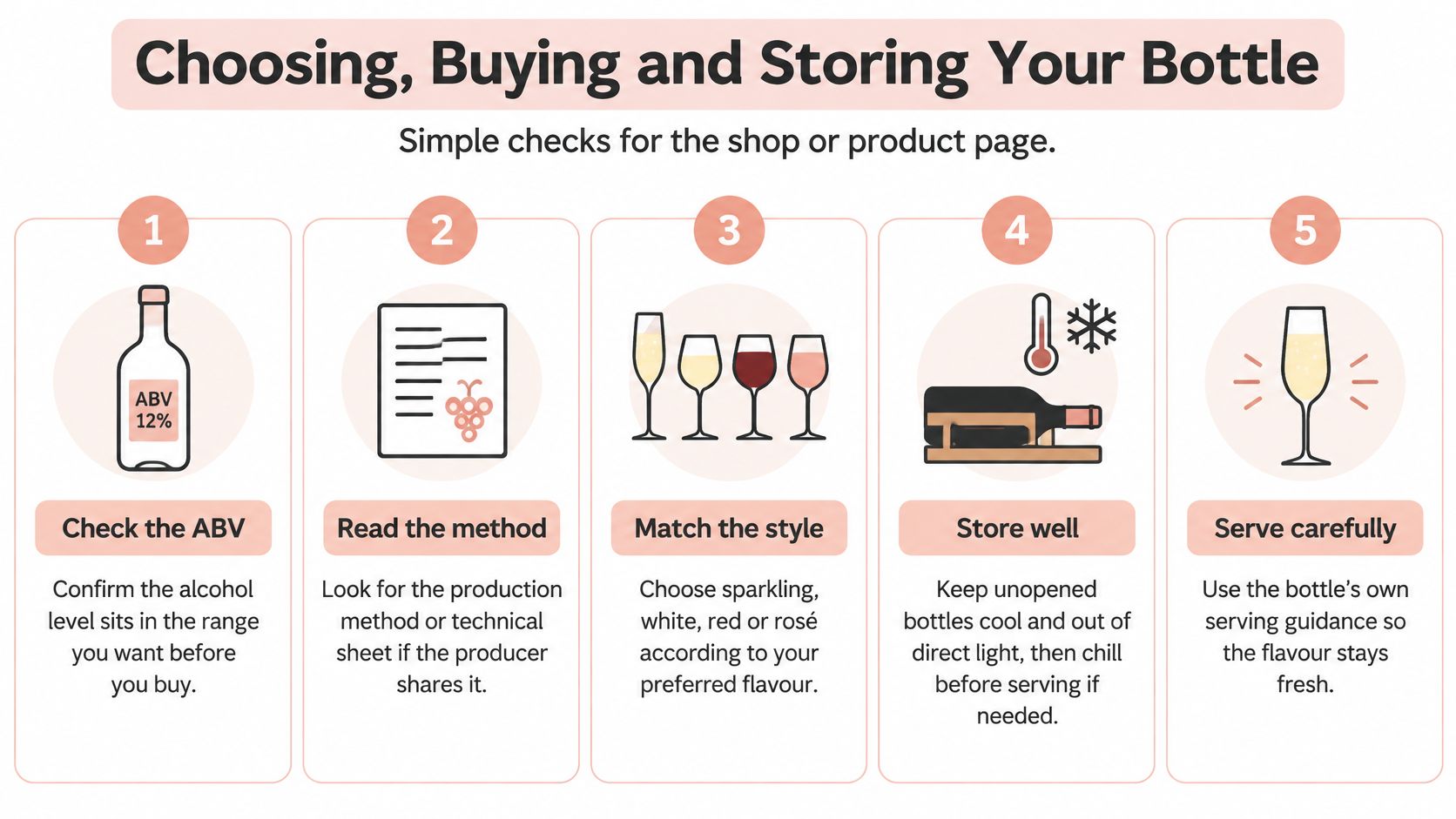
Where to shop and what to ask
On a supermarket shelf, check the front and back labels for the drink's style, ingredients and alcohol declaration. An online product page may also show tasting notes, nutrition information and serving guidance. If you're shopping in an independent wine shop, ask staff to help interpret the notes or find a vegan-labelled option.
Look in the drinks aisle as well as any free-from area. A product's placement can help you find it, but check its own vegan and allergen information rather than relying on the shelf category.
An online vegan deli can make it easier to assemble food alongside your drink. For example, check the ingredients, alcohol declaration and serving notes for Cipriani Bellini Zero instead of assuming it is de-alcoholised wine.
For a bold blue-style pairing, BlueRisella Spreadable Blue Cheese 150g has a creamy, spreadable texture and a tangy, earthy profile. Choose a drink to meet that stronger flavour, rather than treating it like a mild spread.
Keep the bottle in good condition
Store unopened bottles somewhere cool, dark and steady, away from sunny windows and warm appliances. If the label says to refrigerate before opening, follow that instruction.
After opening, refrigerate still drinks and aim to finish them within a few days, unless the producer gives a different period. For sparkling styles, use a sparkling-wine stopper, keep the bottle upright and chill it before serving again.
Storage note: Write the opening date on the bottle. It's easier than trying to remember which evening you first poured it.
For a first purchase, choose a style and a focused food pairing. A soft vegan cheese, plain cracker and separately served chutney give you a simple way to notice how each flavour affects the drink.
For a later gathering, invite a friend to bring a contrasting style and compare your impressions. Browse the current vegan cheese range to plan the food, and speak to a clinician about your individual requirements if you're avoiding alcohol because of pregnancy, medication, a medical condition or recovery.
Serving and Tasting Alcohol-Free Wine at Home
Serve sparkling styles well chilled, whites and rosés cool, and reds slightly cooler than room temperature, unless the producer recommends otherwise. Cooler serving can make sweetness feel less prominent, but excessive chilling can also hide delicate aromas.
A flute helps retain the fizz in sparkling drinks. A wider-bowled glass gives a red more room to release its aroma, making it easier to judge the fruit and finish.
Match the setup to the occasion
- For a dinner party, offer a sparkling style on arrival and a contrasting red with the meal, with food chosen for each.
- For a picnic, pack bottles in a chilled bag alongside spreads, chutney and fine-milled oatcakes. Check the current ingredient and allergen information before serving.
- For Christmas, try a sweet style with a sharp blue-style vegan cheese, keeping sweeter accompaniments optional.
- For a gift, pair a clearly labelled bottle with a cheese bundle, or choose a gift card so the recipient can select food that suits them.
Keep bottles visible, or put their declared ABV beside each serving jug. Guests shouldn't have to guess what they're being offered, and nobody should need to explain why they prefer another drink.
Taste with food rather than in isolation
Pour contrasting styles into separate glasses and smell each before tasting. Take a sip, eat a small piece of cheese, then return to the drink.
Notice whether the cheese makes it seem fruitier, sharper, sweeter or more drying. Use water between combinations and offer another clearly labelled soft drink alongside, so guests have a genuine choice.
For an organised tasting experience, check the current event listing and ask exactly what will be poured. A cheese-and-wine event shouldn't be assumed to include alcohol-free drinks, vegan-certified bottles or an option suitable for strict abstinence.
Common Questions About Alcohol-Free Wine
Can alcohol-free wine contain any alcohol?
Yes. “Alcohol-free” can describe wine with a small residual amount of alcohol, while “de-alcoholised” refers to a different category. Read the declared ABV and the product specification before deciding whether a drink suits your needs. A front-label phrase alone may not answer every question about a particular bottle.
If the information is unclear, ask the producer or choose a drink whose specification you can assess.
Does it taste like regular wine?
Not exactly. Some bottles retain recognisable fruit and acidity, while their body and finish may feel different. With vegan cheese, match the drink to the cheese's texture and flavour: a fresh, tangy style can suit a creamy cheese, while sweetness may balance a sharper one.
You may enjoy it as its own drink rather than as a direct substitute for a favourite wine.
Is it suitable during pregnancy or recovery?
That depends on your circumstances and the product. Discuss pregnancy, medication, health conditions or recovery needs with an appropriate clinician, and bring the product information rather than relying on its category name.
The wine-like ritual may also feel unwelcome for some people. A clearly specified drink that does not imitate wine may be a more comfortable choice.
Saporia is a UK vegan cheesemonger and deli with plant-based cheeses, bundles and accompaniments for a cheeseboard. Browse Saporia for creamy, smoked or tangy cheeses, crackers and chutney to pair with a style of alcohol-free wine you enjoy.